How YC AI Startups Weaponize Offer Data to Replace a Recruiter on Hire One
Live pay data lets founders open with a credible bid, though closing still needs people.

Summary
Live pay data lets founders open with a credible bid, though closing still needs people.
For technical founders making the first engineering hire at an AI startup, the fastest credible process starts with compensation. Live offer data lets a YC founding team price the role, put a defensible bid in the first message, and narrow the negotiation before interviews begin. That replaces much of a recruiter’s offer-setting work, but not the human judgment needed to close a difficult hire.
Why the first engineering hire at a YC AI startup is a compensation problem, not a sourcing problem
Finding an engineer and knowing what will persuade that engineer to join are different problems. AI/ML engineering compensation has pulled away from generalist engineering since 2023, particularly for experience with LLM fine-tuning, eval pipelines, and applied research. At Series A–C startups, those skills command base salaries that a founder cannot reliably price from intuition. An impressive candidate list can bring the founder to an expensive conversation without a credible number.
The uncertainty extends beyond cash into ownership. Pave data shows that median equity for a first founding-engineer hire rose meaningfully between January and April 2026, as AI labs pulled senior engineers at total compensation levels that raised the baseline. A founder pricing from 2024 norms risks undershooting both parts of the package. Memory is a poor benchmark in that market. Most early-stage founders also lack an internal offer history or a recruiter on staff, which explains the traditional appeal of paying a placement fee for someone who knows what candidates will accept. Fonzi, a curated recruiting platform that recommends screened top-tier engineers to AI startups, offers a faster route to a first senior hire without building a process from scratch.
What a traditional recruiter actually does on the offer side, and why that function is now replaceable
A recruiter’s offer-side work has three parts, namely benchmarking, signaling, and compression. Benchmarking establishes what the market pays for a particular profile. Signaling makes the proposed package credible to the candidate before negotiation begins. Compression moves the process from calibration to a signed offer before another company gets there.
Compression is the most time-sensitive part of the service. Founding-engineer finalists can hold two to four competing offers simultaneously, so a company is not negotiating in isolation. Each unanswered compensation question leaves the candidate waiting while another process advances. A recruiter can reduce those delays by calibrating expectations early and keeping both sides moving. Live compensation data can now perform much of the calibration without that intermediary.
Reading hesitation, deciding whether to push on equity or base, and managing counteroffers still require judgment that data does not fully reproduce. The distinction is when that judgment becomes essential. It is most valuable at close, while benchmarking and signaling help keep the candidate engaged long enough to reach that point.
The compensation data layer: where YC founders are actually getting live benchmark numbers
Comprehensive.io has a free-tier salary database with data on 6,000+ US tech companies that is refreshed daily, and it also offers a paid full platform. That refresh rate addresses a practical problem with AI compensation. Quarterly or annual snapshots can leave a founder bidding against a market that has already moved.
Juicebox brings that information into the sourcing decision itself. Its Compensation Intelligence feature draws on a Levels.fyi partnership and combines verified company-page data with AI-estimated pay on candidate profiles. The estimates account for role, company, level, location, and experience. A founder can see a profile and a defensible compensation range before starting a conversation, rather than assembling that context separately through a network and several databases.
The distinction between verified data and an estimate still counts. An AI-estimated package is a benchmark. Its value is that it gives the founder a grounded opening position. Putting that position next to the profile also makes it usable at the moment of outreach. Accessible data becomes a recruiting advantage only when it changes what the founder says to the candidate.
Bid-upfront mechanics: how putting the offer number in the outreach message compresses the entire negotiation
A bid-upfront message puts a credible compensation range or specific number into the first contact. Instead of asking an engineer to spend time discovering whether the company can pay competitively, the founder answers that question immediately. The candidate can engage on known terms. That removes an information gap a recruiter would otherwise spend time closing, and it gives both sides a concrete starting point.
The next conversation can then focus on the gap between the opening bid and the candidate’s target. That is a narrower discussion than asking each side to reveal its range through several rounds of anchoring. A real offer with a company name, full compensation breakdown, and deadline is stronger leverage than a stated preference for more money. The founder’s opening number needs to hold up against another employer’s package, so sounding generous is not enough.
This is also why an arbitrary high-looking number is not enough. The benchmark supplies the basis for the bid, while the candidate supplies evidence about what would change the decision. Where pay-transparency laws apply, posting a range in the job description supports the same direction of travel. The outreach message makes it personal and immediate.
How AI sourcing tools from the YC ecosystem tie the data layer into a recruiting workflow a two-person team can run
Perfectly, a YC W26 company, illustrates how this becomes a workflow. Its recommendation-system sourcing and built-in process link benchmarking, outreach, and applicant tracking in one loop. For a two-person team, that integration is the useful distinction. A larger candidate database would not, by itself, resolve the handoffs between finding someone, pricing the role, and making contact.
Saffron, a YC P26 company, gives candidates a real codebase, records every prompt, diff, edit, and decision, and scores automatically. That shows the founder how the candidate works before the founder commits to a package. Skillsync, a YC W26 company, illustrates a different part of the workflow. It originally analyzed GitHub contributions into searchable skill profiles, but has since pivoted to capturing and sharing AI agent sessions, so its former sourcing product should not be treated as a current buying recommendation.
Public work signals narrow the candidate pool, compensation data supports the opening bid, and a codebase exercise informs the hiring decision. Automation links tasks that a founder would otherwise have to keep track of by hand. It does not remove the decision itself. The operational gain is a smaller set of candidates entering a process with clearer pay expectations and a direct test of whether they can do the work.
What this playbook means for the candidate side: transparency as a two-way signal
For an engineer, a credible opening bid reveals something about the founding team beyond its budget. It shows that someone has done the benchmarking work before asking for time. That is a useful hiring-quality signal. Engineers quietly considering a move from a startup or big tech can read a vague range, or no range, as a warning about how later compensation conversations might work. A clear number makes the first interaction easier to evaluate without requiring a commitment to interviews.
AI screening creates real resistance among candidates, particularly when it feels impersonal or its role is hidden. A process can therefore build trust with an upfront bid and lose it at the next step. An engineer needs to understand both what the company might pay and how the company intends to judge the work.
The stronger version of this process discloses the AI-screening step and frames it as a codebase exercise. Saffron’s recorded prompts and diffs provide a concrete example of the work such an exercise examines. Disclosure lets the candidate decide with the relevant information in view, though some candidates may still decline to participate. For founders, that keeps the assessment process consistent with the openness established by the first message.
Where the playbook breaks down: the cases where a human recruiter still wins
Some candidates are reachable through trust. Alumni of OpenAI, Anthropic, and DeepMind can command a thirty to fifty percent premium and often operate through tight networks. A trusted human relationship may be the access mechanism. Accurate compensation data cannot make cold outreach equivalent to that relationship, and candidates with strong alternatives may decline an AI-only process. For those searches, recruiter access and judgment remain distinct advantages.
With equity, a benchmark cannot explain the risk that comes with ownership. Seed and Series A candidates need a human conversation about funding, runway, dilution, and realistic outcome scenarios. A percentage alone leaves too much unresolved. Cash data can support the opening package, but it cannot compress that entire discussion into an outreach message. The founder still has to explain what the ownership could mean.
There is also a prior question about whether to hire. For a pre-PMF company with limited runway, outside an AI-frontier or compliance-heavy stack, the stronger move may be to skip the founding-engineer search. A senior contractor on a fixed-price sprint can ship the MVP, followed by validation with paying users and a post-PMF hire onto a real codebase. Better offer data cannot tell the founder when to hire. Faster recruiting is useful only after the company has established that a permanent hire is the right commitment.
How do you hire your first senior engineer when you have no recruiting process and no time?
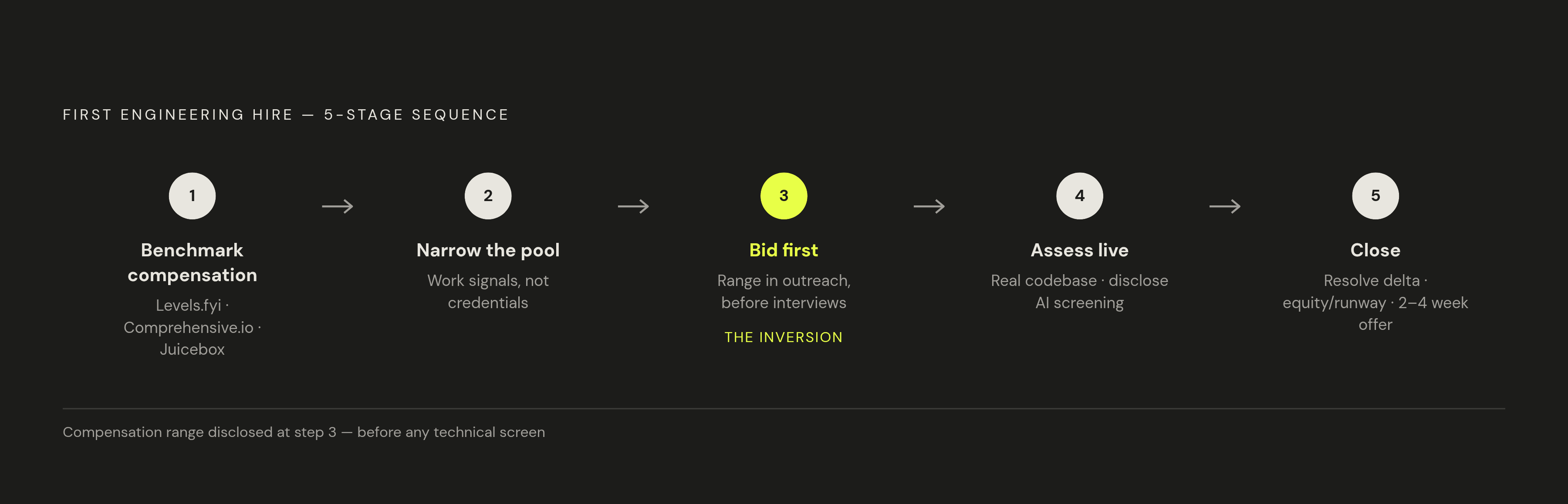
For a founder whose company is ready to hire, the practical sequence starts before writing outreach. Use Levels.fyi for verified total compensation by company and level, and Comprehensive.io for base salary data across companies that is refreshed daily. Use Juicebox’s compensation feature when sourcing and pricing happen in the same view. Establish the number before drafting the pitch. Keep the distinction between verified figures and estimates visible when deciding what package the company can credibly put forward.
Next, narrow the search by looking at work people have done as well as their credentials. Perfectly’s recommendation-system sourcing is one way to do this, while Skillsync’s former GitHub profiles show how the work-signal approach works but should not be assumed to be a product it still offers. Then put the credible bid in the first outreach message. Post the range in the job description where transparency laws apply. Early outreach tests whether the role and package fit before either side invests in a longer process.
After that initial alignment, assess the candidate on a real codebase and disclose how AI will influence the evaluation. Saffron’s recorded-session assessment is one way to get a scored work signal before the offer conversation. Use that conversation to resolve the remaining compensation delta. Be ready to explain funding, runway, dilution, and outcome scenarios directly, with Pave’s documented equity shift informing expectations.
Keep the sequence tied to the candidate’s deadline. A founding-engineer search typically has a two-to-four week time-to-offer window, and finalists may already be weighing several alternatives. Compare processes by their ability to deliver a credible package while the candidate is still available.

