What Technical AI Founders Use Instead of Recruiting When They Need an Engineer Now
A four-step search order that cuts AI hiring from months to days.

Summary
A four-step search order that cuts AI hiring from months to days.
For technical founders making the first engineering hire at an AI startup, the fastest route is an ordered search. Start with referrals from people the founder trusts, then look at work shared in the community, curated matching services, and AI-powered outbound if more candidates are needed. The playbook compresses sourcing from a 95-day hiring process into days, but only if the founder can decide quickly.
Why the standard 95-day AI hiring timeline is a startup killer
The average time to hire an AI engineer has grown to 95 days, meaningfully longer than the prior year. Many people are looking for jobs in general software engineering, but AI specialists rarely stay on the market. Those who leave a company or get laid off are typically absorbed in days. A slow process misses them entirely.
The shortage is structural, with far more open AI positions than qualified candidates worldwide. A founding engineer search narrows the overlap further because it can demand LLM API integration, RAG architecture, eval framework design, inference cost management, and research paper fluency on top of normal founding-engineer expectations. Posting a job and waiting is the slowest way to find someone with this rare mix of skills. Yet the founder has no recruiting team, no employer brand, and no applicant tracking system to make even that process run.
How do technical founders hire their first senior engineer with no recruiting process and no time?
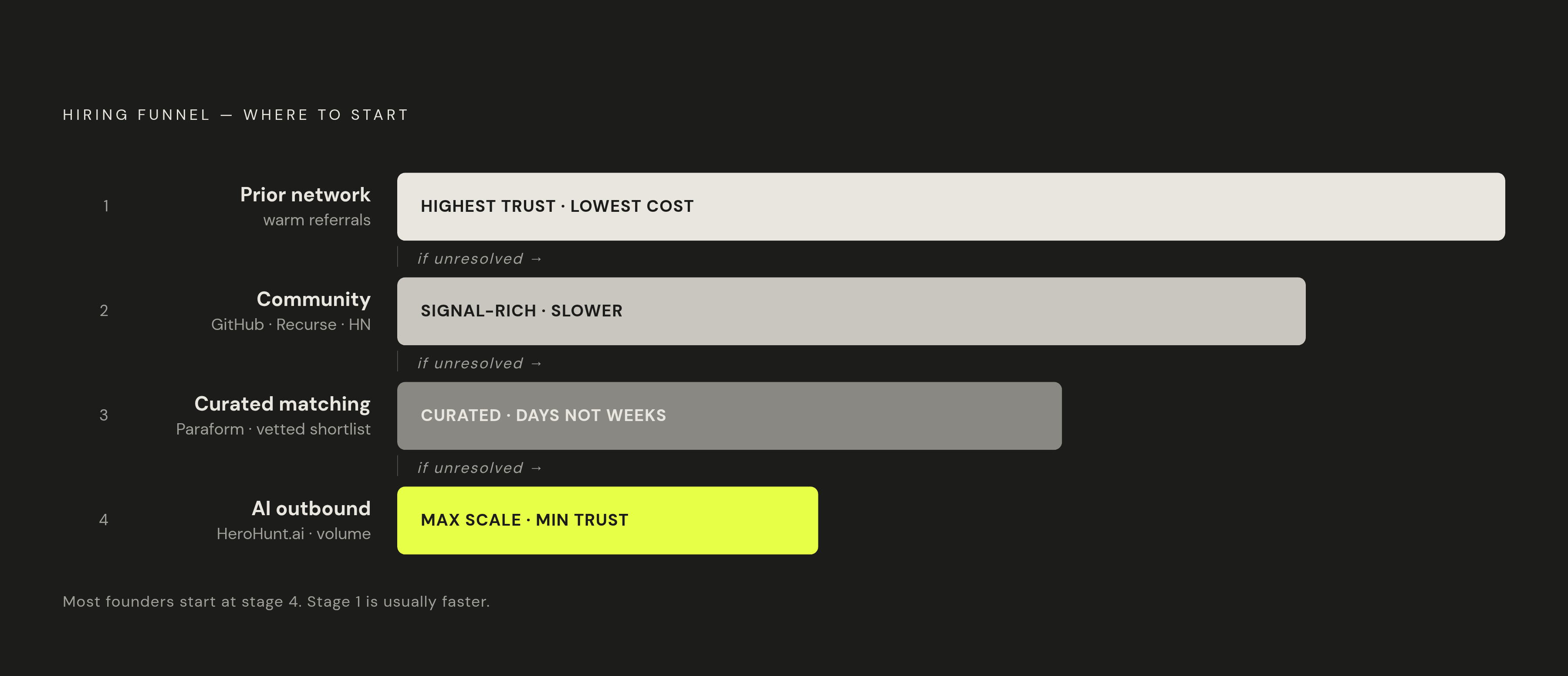
Founders who hire fast put the strongest evidence first. They start with people whose work they already trust, then look for strangers whose work is visible, then pay for compressed vetting when those routes have not closed the search. AI-powered outbound comes later, when the search needs more candidates than the founder can gather by hand. Without a recruiting team to screen inbound applicants or a CRM to manage outreach, every extra channel consumes time that could go into the product.
Before entering that sequence, the founder has a separate decision to make. Does the company need a permanent team member, or does it need someone who can make specific calls and do the work right now? Fractional and contract work can meet that second need. Once the need for a full-time hire is clear, the search starts where the founder has the least uncertainty and the shortest path to a useful conversation, which is the prior network.
Starting with the prior network and why warm trust compresses timelines more than any tool
Recruiting from Scratch’s 2026 founding engineer guide lists the prior network as the first channel most founders use. Passive candidates at top AI companies rarely apply through standard postings, while someone who has shipped with an engineer can tell the founder things that a stranger’s application cannot. The referrer knows more than whether the candidate can discuss a technical problem. Having worked with the engineer, the referrer gives the founder more to go on when judging whether that person can help build the company.
For YC-backed founders, the YC alumni network concentrates hundreds of engineers who have done the founding engineer job before. Shared context makes outreach easier to place. Another specific group is AI startup alumni who joined a founding team at a Series A AI company and want to do it again. They have already chosen the founding-engineer role once, which makes them more relevant than a broad list of people with AI in their profiles.
A network without AI engineers can still contain useful connectors. Investors, co-founders of portfolio companies, and advisors who have hired this profile can reach one degree further. The practical move is to ask those people before starting cold outreach. But the network runs out, especially for first-time founders. When those introductions stop leading to candidates who could fit, community sourcing is the next way to find engineers whose work the founder can see before an interview.
Community-native sourcing: finding high-signal engineers where they already demonstrate their work
A commit history shows what someone built and when, while a resume shows what they chose to claim. That distinction is especially useful for a small team that cannot absorb a hiring mistake. Contributor graphs let a founder start with work that could help build the product, then find the people who did it.
They built something and chose to show it to peers. The meetup network spans many cities and has a substantial global membership, giving founders a route beyond their immediate contacts. Recruiting from Scratch’s guide also names Recurse Center AI-focused batches and contributors who did quality early work on projects such as LlamaIndex or DSPy.
Availability is a separate question from technical skill. Hacker News’s “Who wants to be hired?” threads surface engineers who are already open to a move, avoiding some of the difficulty of reaching passive candidates. Its “Who is hiring?” threads provide a free posting route, with one post per company per month. HeroHunt’s AI recruiting guide also cites Allstate’s Kaggle recruiting competition, which drew thousands of participants as a way to surface skilled candidates at scale.
Research-adjacent roles need a different pool of people. NeurIPS, ICML, CVPR, and ICLR can connect founders with PhD students and research community members, although their career fairs are not a fast channel. These routes offer different profiles. These routes also take time from the founder, who has to read contributions or go to meetups. When that time cost becomes the obstacle, matched services offer a way to pay for faster vetting.
Curated matching services: what founders use when they need a vetted engineer in days, not weeks
Curated matching services earn their place when warm referrals and community sourcing have not closed fast enough. They trade money for time the founder lacks. The comparison is not simply which service promises speed, but what kind of speed and candidate it provides. Some services focus on getting the first shortlist ready, while others focus on people who have worked in research labs, share a time zone, or can work as a dedicated engineer before a full-time hire. A fast introduction is useful only if it matches the actual engagement.
NextDev’s 2026 platform comparison reports that Paraform’s vetting funnel accepts fewer than three percent of applicants. The same comparison says more than 70% of engineers who pass previously worked at OpenAI, Anthropic, Google DeepMind, or Meta AI. That makes Paraform a fit for seed and Series A startups that want ML engineers who have worked in research labs. The pedigree is most useful when those backgrounds match the work the startup needs done.
The comparison also cites a YC-backed startup that moved from several weeks of inbound screening to three days to final offer. Its first Paraform hire shipped a production model improvement within two weeks of joining. Before engaging a service, the founder should settle whether the need is a full-time hire, a dedicated engineer for six months or more, or a scoped project. Getting that choice wrong wastes the time the service was meant to save.
AI-powered outbound sourcing: scaling the top of funnel when the pipeline needs volume
AI sourcing tools become useful when the earlier channels have not produced enough candidates and matched services are not the right fit. Sourcing by hand can take two to four hours per candidate. Across multiple searches, that becomes a substantial claim on a founder’s month. AI sourcing can reduce the gathering work to minutes per candidate, giving a solo founder a recruiting team’s data-gathering capability without adding headcount. It does not supply the hiring judgment.
The workflow begins with a plain-language description of the engineer needed. Systems find candidates across GitHub, LinkedIn, X, and Stack Overflow, score proof-of-work signals, and verify contact information for outreach. The founder still makes the judgment calls. HeroHunt’s 2026 recruiting guide describes how HeroHunt.ai searches a large pool of profiles for candidates who match a written role brief.
Finding someone does not make that person interested. Passive engineers ignore InMail sent from a template and reply to messages that mention work they have done. That leaves an important part of outbound with the founder, even when the search itself is automated. The tool can supply candidates and contacts, but the founder still has to explain why this engineer’s work connects to this company’s problem. More names cannot compensate for a message that gives them no reason to reply.
Fractional and contract engagement as an alternative to the hire itself
For a startup still looking for product-market fit, the role may change a lot over the next six months. A need for fine-tuning, RAG architecture, or eval framework design may be a need for a specific capability. Fractional or contract engagement can address that narrower problem immediately, without a full recruiting process or a six-month ramp. The work need not wait for the permanent hire.
That option has limits, and they are important. Fractional work is a poor fit when the company needs someone embedded in its product and culture for more than a few months. It also fits poorly when the work depends on institutional knowledge that builds over time. A team ready to offer equity may find full-time employment more competitive than fractional rates.
What determines whether the playbook closes fast or stalls
The first execution decision is to name the job accurately. An AI engineer usually turns existing models into a useful product, while an ML engineer makes ML systems reliable and scalable. A research scientist creates or validates new methods. These are different searches, with different pitches and sources of candidates.
Recruiting from Scratch’s 2026 ML research hiring guide develops another distinction for early-stage teams. Most Series A/B AI startups need a research engineer, with a pure research scientist needed when research output is the core product, as it is for a foundation model company. The title alone is not enough to decide. A founder should evaluate candidates on what they have shipped rather than use credentials as a substitute for relevant work.
Starting with the network still leaves room to try another channel while referrals are pending. When the role is urgent, founders should use community sourcing and matched services at the same time after first asking their network. That deliberate overlap buys time without committing the founder to every sourcing method at once.
Finally, sourcing speed is wasted by a slow decision. A founder who finds a strong engineer and then leaves the candidate waiting gives another company room to close. The practical requirement is to make the offer before the candidate’s other conversations finish, rather than stretch the internal decision loop after the evidence is sufficient. The best engineers leave open processes fast. The founder has to be ready to act when the right one appears.