ML Engineer vs. Research Engineer Compensation Differences
Title matters less than employer tier, but equity, not salary, drives the research premium.

Summary
Title matters less than employer tier, but equity, not salary, drives the research premium.
The compensation gap between ML Engineers and Research Engineers depends heavily on which archetype a given title actually refers to. It cannot be measured accurately until three commonly conflated archetypes get separated: AI Engineer, ML Engineer, and Research Engineer. Lump them together and the gap disappears into noise.
"ML Engineer" covers wildly different jobs under one title. Someone building recommendation systems at a Series D startup and someone fine-tuning foundation models at a frontier lab both carry the title "ML Engineer," but they don't share a job, a skill emphasis, or a pay band. The same divide between production work and research sensibility appears between Research Engineer and Research Scientist. The hybrid Research Engineer role combines production engineering capability with research sensibility, so it sits between ML Engineer and Research Scientist on the spectrum. Salary surveys routinely fold it into one bucket or the other, depending on who built the survey.
The result: most salary comparisons an engineer finds mix these populations together, producing a range wide enough to support almost any conclusion someone wants to draw from it. Fonzi looked into engineering org composition at elite companies and found this gap. Titles stay identical across frontier labs, hyperscalers, and early-stage startups, but pay bands, equity structures, and career trajectories diverge sharply underneath those shared titles, and most salary surveys collapse all three into a single range despite that divergence.
Employer tier determines pay bands and equity structures more directly than role track does, and it should be assessed first. A frontier lab ML Engineer and a hyperscaler ML Engineer have the same title, but they sit inside different pay structures. You can only compare ML Engineers and Research Engineers once you hold employer tier and role type constant. Without that step, the comparison measures nothing.
Daily work and deliverables across the three role archetypes
The three archetypes diverge most sharply in what they ship, not in what skills they carry on day one. A strong engineer could plausibly do any of these three jobs. What separates them is the deliverable each role is built around.
The AI Engineer builds product features on top of models that already exist. The work centers on prompt engineering, RAG pipelines, evals, and integration work. Training a model from scratch rarely enters the job description.
The ML Engineer, on the applied track, builds, trains, and operates ML systems in production. Ownership runs from pipeline to production: model serving infrastructure, feature stores, experimentation frameworks, and operational reliability at scale. The deliverable is a shipped feature that keeps working.
The Research Engineer, on the hybrid track, builds the infrastructure and runs the experiments that produce new model capability. The role sits at the intersection of production engineering and research, and it demands deep ML knowledge, production engineering skill, and research sensibility all at once. Few people can do all three well, which is part of why the role is rare.
The Research Scientist advances novel methodology: architecture research, scaling-laws work, publication-track contributions, benchmark-pushing results. The deliverable is a finding or a paper, not a shipped feature.
Recruiting Fromscratch's comparison of these tracks characterizes applied ML engineers as emphasizing practicality and software engineering foundations, while research engineers concentrate on theoretical advancement, experimental design, and frequently publish findings. That split carries into how each track gets recognized inside an organization. Engineering-track recognition runs internal: promotion, product-impact metrics, the things a manager tracks on a review cycle. Research-track recognition runs external: publications, conference talks, named-author status on a paper the field actually reads. That difference in how recognition works shapes what each employer is willing to pay for.
Base salary
At the same employer tier and the same seniority level, base salary differences between ML Engineers and Research Scientists exist but are modest. The dramatic number that circulates in engineering forums and comp threads lives somewhere else entirely, not in base salary.
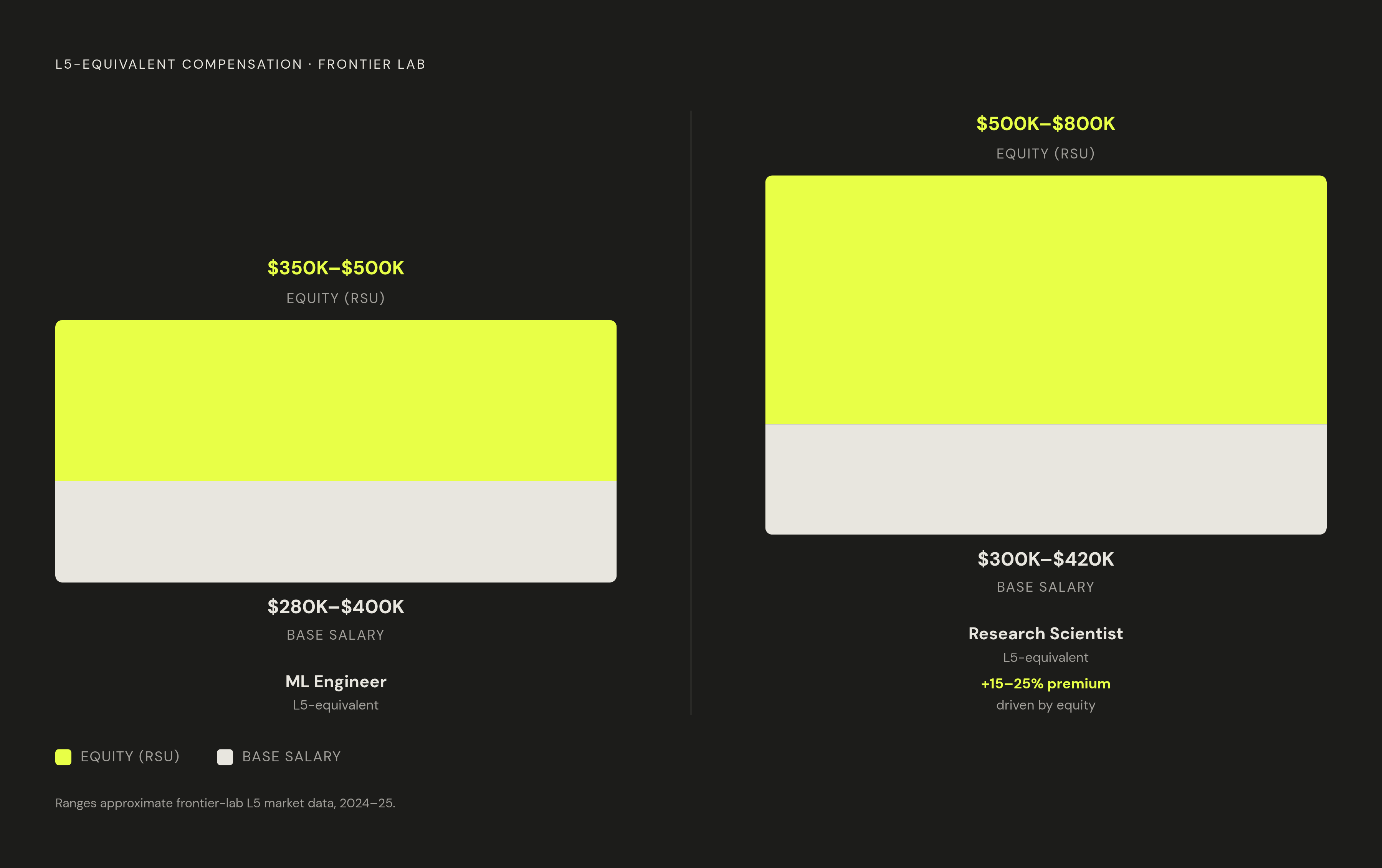
At the L5-equivalent level at a frontier lab, ML Engineer base salary runs $280K to $400K. Research Scientist base salary at the same tier and level is a bit higher. The two ranges overlap substantially. A Research Scientist earns more on average, but plenty of ML Engineers out-earn plenty of Research Scientists on base alone, simply based on where each person lands inside their respective range.
What actually drives the wide salary ranges engineers encounter in practice is employer tier, far more than track. Frontier lab, hyperscaler, startup, non-tech industry: that axis explains more variance than ML Engineer versus Research Scientist does. An ML Engineer at a frontier lab earns more than a Research Scientist at a regional company, full stop on the comparison logic, because tier dominates track at the base salary level. Geography compounds this. When you benchmark compensation across cities and company types, the ranges can feel contradictory, because tier and track are two different variables moving at once inside the same published number. That's part of why direct conversation with engineers who've actually negotiated at a specific tier and employer tends to produce more reliable information than an aggregate survey: the survey can't separate the variables, but a person who lived through one specific negotiation can tell exactly which variable moved their number.
Why equity is where the research track premium concentrates
The meaningful compensation difference between ML Engineers and Research Scientists appears in equity, not base salary. Seeing why reveals what each employer is actually paying for.
At a frontier lab, L5-equivalent equity grants run noticeably higher for Research Scientists than they do for ML Engineers. That spread is wider than the base salary differential, and it's the main driver behind the overall 15 to 25% Research Scientist premium in total compensation. Base salary explains a small piece of that premium. Equity explains most of it.
Frontier labs treat research-track contribution to foundation-model capability as a direct input into their core competitive asset, the model itself, which is the mechanism behind that spread. Equity is the instrument labs use to price that contribution, because it ties a researcher's personal upside to the lab's own model progress. Pay someone in equity tied to the thing they're improving, and their incentives point the same direction as the company's.
The Research Engineer hybrid role earns its own distinct equity premium over standard ML Engineering, for the same reason. The role needs deep ML knowledge, production engineering capability, and research sensibility all at once, and that combination is scarce enough that labs price it above standard engineering bands. At the senior level, senior Research Engineer and senior Research Scientist total compensation climbs well above standard ML Engineering bands at the same seniority.
That has a direct negotiation implication. Most candidates spend their negotiation energy on base salary, which is usually the least flexible part of an offer; a recruiter has a band, and that band rarely moves much. Equity, specifically RSUs, is where the actual negotiation happens, and the research track's premium concentrates almost entirely there. So if frontier labs use equity grants to price research-track contribution, that changes what you should ask for. The ask is a revised equity band that reflects the specific capability an engineer brings to the lab's core competitive asset. Equity conversations also require knowing the vesting cliff, the refresh cadence, and the refresh strategy at a specific employer, details that salary surveys almost never capture. Engineers weighing an ML Engineer offer against a Research Engineer offer at different employer tiers tend to get more out of talking to peers who've actually navigated that exact choice than out of a generic equity benchmark that can't see company-specific practice.
How employer type reshapes the comparison
The frontier-lab picture, Research Scientists earning a real premium concentrated in equity, is one employer context among several, and the premium reverses or disappears entirely depending on which context an engineer is actually looking at.
Frontier AI labs are where the premium lives. Acceptance rates for Research Scientist and Research Engineer roles at the top labs, such as Google DeepMind, run below 1%. Compensation reflects that scarcity directly, and both the research premium and the absolute pay ceiling exist primarily at this tier.
Hyperscalers compress the gap substantially. These companies standardize compensation bands across tracks more aggressively than frontier labs do, so the premium for Research Scientists over ML Engineers shrinks to something small relative to what a frontier lab pays for the same distinction.
Startups invert the logic entirely, and this is where the comparison matters most for the audience actually making career moves right now. Recruiting Fromscratch's active job posting data puts the median base for applied ML engineers at a competitive level in this market. Research engineers in that same market earn a similar or slightly lower range, especially coming out of academia. At seed-stage AI startups, researchers may command higher base salaries than applied engineers on paper, but the right hire for most seed companies is applied. Researchers optimize for novel modeling. Seed companies need someone who can turn prompts and fine-tunes into reliable production features, and who can ship weekly. If a brilliant architecture idea never ships, it doesn't keep a ten-person company alive.
The production gap appears at every tier, but it takes a different form depending on tier. In the broad ML Engineer market, production deployment experience is the clearest compensation driver available. Companies pay for engineers who can build, deploy, monitor, and fix ML systems in the real world, and the supply of engineers who can do that reliably stays thin. That scarcity holds regardless of whether the employer is a frontier lab, a hyperscaler, or a startup, which makes production experience one of the few compensation signals that travels across every tier intact.
The credential gate and its effect on career mobility in each direction
Compensation is only part of what separates these tracks. The research track's premium comes with a structural access cost, and the mobility patterns on each side of that gate run in asymmetric directions that outlast any single compensation decision.
A PhD remains the dominant credential for Research Scientist roles, but it isn't formally required at every frontier lab. Anthropic and OpenAI both accept an equivalent research record in place of a PhD for Research Scientist intake. For ML Engineers, a PhD appears commonly in candidate backgrounds but isn't strictly required. This credential gate compresses the Research Scientist supply pool, and that is what supports the wage premium discussed earlier. It also means most engineers can't access the research track without a credential investment made years earlier, long before any specific job offer enters the picture.
Market liquidity runs in opposite directions for the two tracks. ML Engineers carry broad external market liquidity, and they can land jobs across tech, finance, and general industry. Research Scientists face a narrower market concentrated at frontier labs and academia. Research Scientists keep academia open as a future option, but ML Engineers keep broader industry mobility open. Neither option is strictly better, but they point different directions.
Promotion timing differs too. ML Engineers often reach promotion faster, simply because there are fewer Research Scientist slots, and they run more competitive at every level. So the research premium in pay comes with a real bottleneck in research-track advancement.
Mid-career transitions happen in both directions, but unevenly. Senior ML engineers who entered industry without a PhD sometimes aim for a research-track role mid-career, and they often take a short-term pay cut to join a smaller frontier lab, where credentialing requirements run looser. That cut reflects lab size, not the role itself, since the research track still pays more at equivalent levels. The reverse transition happens less often: a Research Scientist moves into ML Engineering, typically once the publication-track recognition model stops feeling as rewarding as direct product-engineering impact. Moving from research to applied requires building software engineering skill and gaining real production-system experience. Moving from applied to research requires demonstrating experimental design capability and, ideally, a publication record. Track choice carries mobility consequences that compound over years, so the compensation snapshot covers only part of what an engineer needs to see before choosing a direction.
How the interview loop encodes the track philosophy
The interview loop is a direct expression of what each role is actually expected to deliver. Reading it correctly helps an engineer calibrate preparation, and it helps identify whether a "research engineer" title is genuinely on the research track or whether it's senior ML Engineering wearing a different name.
OpenAI's final loop runs across multiple hours over one or two days, and the full process can take four to eight weeks end to end. OpenAI's process weighs coding more heavily than research discussion, so you need to be a strong engineer first, whatever the job title says.
Google DeepMind tests undergraduate-level fundamentals through a rapid-fire quiz round, a format most other employers don't use. The process has been described as a PhD defense mixed with a rigorous engineering exam, and that combination encodes DeepMind's expectation of deep theoretical grounding alongside engineering competence.
Applied ML Engineer loops at startups tend to run shorter and weigh practical system design and production experience heavily, which lines up with what those employers are actually buying: someone who can ship.
The diagnostic value here carries past the interview itself. A loop that tests publications and paper discussion signals genuine research-track expectations on the other side of an offer. A loop that tests coding speed and system design signals that "research engineer" in the job title is closer to senior ML Engineer in practice. The loop previews the equity structure discussed earlier: it shows what the employer actually values before any number appears on paper.
The market pressure quietly compressing the research premium
Two forces are pressuring the research premium from opposite directions at the same time. Ignoring either one produces a career plan built on a snapshot that's already moving underneath it.
Pressure from below comes from foundation model commoditization. A product engineer with API documentation now handles work that needed a dedicated research team just three years ago. The "Rise of the AI Engineer" argument captures this directly: capability that once demanded research-track talent now sits a few API calls away from a competent generalist. That shift is why AI Engineers, the people building on top of foundation models rather than training them, command a scarcity premium in 2026 despite the role barely existing a few years earlier. As commoditization keeps climbing, the floor beneath research work keeps rising too, narrowing the gap from underneath.