Software Engineer Salary Bands at Series A AI Startups
How company stage, role specialty, and shipped work reshape pay at Series A AI startups.

Summary
How company stage, role specialty, and shipped work reshape pay at Series A AI startups.
Series A AI startup pay is a stack of separate bands, and level, specialty, and whether a candidate has actually shipped production AI systems each push that stack in a different direction. An engineer who walks into an offer conversation holding one average number from a salary site will misread almost every offer put in front of them, because that number was never describing their situation.
Part of the blame sits with the salary aggregators themselves. They lump together an internal-tools engineer at a thirty-person company, a contractor at an agency shop, and a staff AI engineer at a well-funded lab, then publish one median for a job title that covers all three. What comes out the other end is a reflection of who happens to hold that title across the whole population, not a number tied to the market any one engineer is actually competing in.
The fix is to stop asking "what does an AI engineer make" and start asking three narrower questions instead: what stage is the company, what is the actual specialty inside the broad job title, and has this candidate shipped production AI work before. Those three variables are what the averages wash out, and this piece is going to walk through them one layer at a time.
The cash-versus-equity baseline company stage sets before any other variable enters
Company stage decides the cash-versus-equity trade before anything else about the role, because every funding round sets a different balance between saving cash to extend runway and paying what the market demands.
At seed, equity is doing most of the talking. Cash stays modest so the company can stretch its runway, and the bet an engineer is making is mostly on the equity line, not the paycheck. By Series A and into Series B, cash climbs steadily toward market rate with each round, and the balance starts to shift back toward a paycheck an engineer can actually live on day to day. At growth stage, cash is at or near full market rate, and equity, while smaller as a percentage, still carries real weight because the company has already proven out a chunk of its risk. At the very top of the ladder sit the frontier AI labs, where a genuine shortage of specialized talent pushes total compensation above everyone else on the spread.
Senior AI engineers see this ladder in sharper detail. As of April 2026, a senior AI engineer at a seed-stage company, typically a team under two dozen people, can expect a competitive base paired with equity in the 0.5% to 1.5% range. Move to Series A, where the team has grown past that early headcount: the base climbs higher than what seed paid, while the equity grant shrinks to a fraction of a percent. By Series B, with a larger team and more maturity behind the company, base keeps rising and the equity slice keeps shrinking in proportion.
None of this means one stage is better than another. It means the same base salary offered at a Series B company and at a seed-stage company is not the same offer, because the equity attached to that number is compensating for a completely different level of risk. The startups that do best in these conversations name the actual gap between their cash offer and what a frontier lab would pay and put an honest price on the equity upside. That kind of straight talk wins more candidates than arguing the gap doesn't exist.
What Series A pays, broken out by role type
Inside Series A itself, role type splits the band further, and one of the most common ways engineers walk into a negotiation underprepared is treating every engineering title at a Series A company as interchangeable.
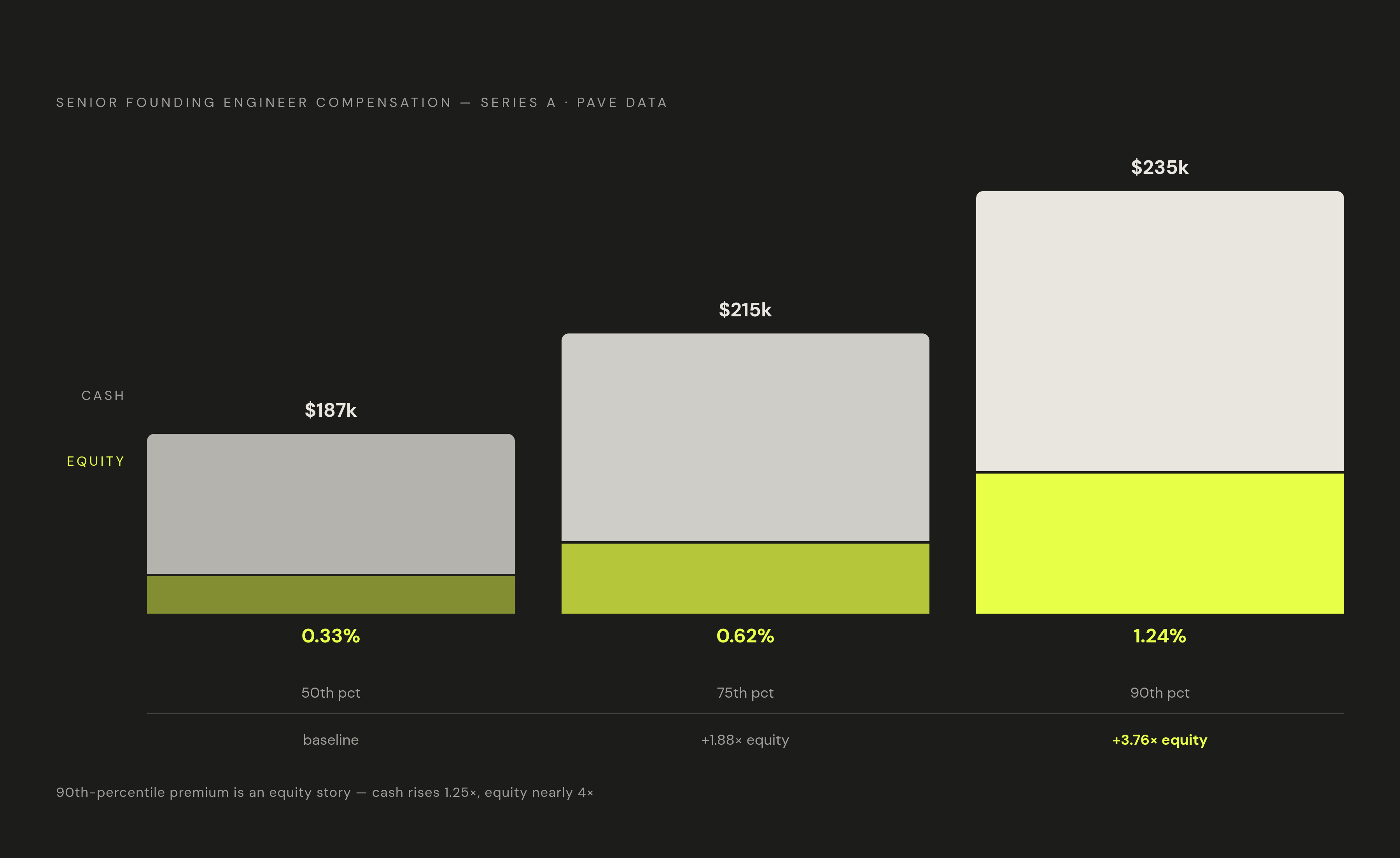
Founding engineer is its own category, and it means something specific: one of the first one to five technical hires, usually joining pre-product-market-fit or close to it, sometimes even at the seed stage before the Series A round closes. Pave's compensation data breaks senior founding engineer offers into three tiers. At the 50th percentile, a senior founding engineer sees $187,000 in cash plus 0.33% equity. At the 75th percentile, that rises to $215,000 cash with 0.62% equity. At the 90th percentile, the package reaches $235,000 cash with 1.24% equity. The spread between the 50th and 90th percentile is not just a bigger paycheck, it's close to four times the equity grant, which tells you how much the top of the market is paying for scarcity and leverage, not just skill.
Remote work changes the picture less than it used to. Most AI-native startups now run a single national salary band with only a moderate discount applied for engineers outside major coastal markets. That is a real shift from earlier in the decade, when remote offers outside major coastal tech hubs routinely took steep cuts. An engineer evaluating a remote Series A offer today should expect something close to the national band, not a number discounted the way it would have been a few years back.
How seniority level reshapes the band at every stage
Level is the second independent variable, separate from stage, and it moves the number by enough that a mid-level engineer and a staff engineer at the exact same Series A company are not looking at two versions of the same offer. They are looking at two different financial decisions.
Start with the general software engineer bands for 2026, measured in US base salary. A junior engineer or new grad, zero to two years in, starts at a modest entry-level floor and can reach a competitive upper range depending on the company and the percentile. Mid-level engineers, the SWE II or L4 band at two to five years, see the range widen a lot more, with top-percentile pay running well above the median for that level. Senior engineers, SWE III or L5 at five to ten years, sit inside an even wider spread, where the top earners make roughly double what the bottom of that band makes. Staff and principal engineers, eight to fifteen years in, sit on the widest band of all four levels, with the top percentile paying more than double the bottom.
At the staff level, which company someone works for changes total pay more than any other factor in the role. A staff engineer at a mid-market SaaS company earns roughly what a senior engineer earns at a traditional top-tier tech company like one of the FAANG firms, and meaningfully less than a senior engineer at a top-tier AI company such as OpenAI or Anthropic. At the same seniority level, title alone tells you very little once company tier enters the picture.
RSU refreshes add another layer on top of base once someone reaches senior and above. A senior engineer at a top-tier company who performs well will see total compensation climb substantially year over year just from refresh grants, separate from any promotion or role change.
The AI and ML specialty premium layers on top of all of this and compounds what level already set. A mid-level AI engineer does not simply earn what a senior generalist earns just because AI carries a premium. The specialty premium and the level band interact. Both variables have to be read together, not swapped in for each other, to land on an accurate number.
The AI and ML specialty premium within a single job title
Specialty is the third variable, and it's the one most engineers underestimate, because the job title on a listing no longer reliably tells anyone which pay curve actually applies. AI and machine learning roles carry a real premium over standard engineering pay, and that premium grows with seniority and with research depth, but it is far from uniform across the different jobs hiding under the same broad label.
Recruits Lab now tracks AI Product Engineer, ML Platform Engineer, LLM Engineer, and AI Research Engineer as four distinct markets, each with its own comp curve. Two people with the same job title on a resume can be sitting in entirely different pay brackets depending on which of these four buckets their actual day-to-day work falls into.
The gap is sharpest between research scientists and ML engineers. Research scientists earn a substantially higher median than ML engineers, and at the 90th percentile the gap widens even further, with research scientist pay reaching dramatically higher numbers. That steep top end is also where most of the public confusion about AI pay comes from. The headline comp figures that circulate in the press almost always describe that extreme upper curve, the research scientist at the 90th percentile, not the median ML engineer most companies are actually hiring for. Reading those headlines as a description of typical AI engineer pay is one of the fastest ways to walk into a negotiation with the wrong number in mind.
Shipping production AI systems as a separate pricing signal, not just a resume credential
Production experience has stopped being a line on a resume that helps during performance review season, and started being a variable priced directly into the offer itself, before negotiation even opens. Engineers who have shipped real production LLM applications, things like RAG pipelines, agent orchestration systems, or LLM evaluation harnesses, are commanding offers that sit well above otherwise-identical candidates who haven't done that specific work, and at many companies that premium is already baked into the band before an offer letter goes out.
Recruits Lab measured AI engineer compensation climbing substantially through 2025, the largest single-year jump the firm has tracked across any engineering specialty. The driver wasn't AI hype broadly. It was a genuine supply shortage of engineers with 18 or more months of production LLM experience specifically, a much narrower pool than "has used an LLM API" or "built a chatbot demo."
That shortage appears in who is actually applying for these jobs. Most inbound applicants to AI engineer postings are mid-level engineers making the jump over from general software roles, not candidates with deep production AI backgrounds. True senior and staff-level AI engineers with real production track records aren't sitting in that applicant pool. Companies have to go find them directly, because they aren't the ones responding to job posts.
That scarcity is also changing which offers engineers choose to accept. A meaningful share of engineers are now taking startup offers over offers from frontier labs, according to Recruits Lab's placement data, and that mostly happens when the startup makes its equity story and the candidate's product autonomy explicit. Production experience is the lever an engineer can pull right now to move into a higher band, not just a credential that pays off eventually.
Equity at Series A and the compression trend for founding versus standard hires
Equity is the half of the offer most engineers read wrong, usually because they're comparing it against numbers from a market that no longer exists. Grants at Series A AI startups have come down from the peaks seen in 2021, and anyone negotiating against those old benchmarks will both misjudge what's actually on the table and fail to ask the right questions about what that equity is really worth.
Recruits Lab's founding engineer guide puts the realistic ceiling for pre-seed founding hires well below what was common earlier in the decade. The outsized grants that circulated back then have largely disappeared from the market.
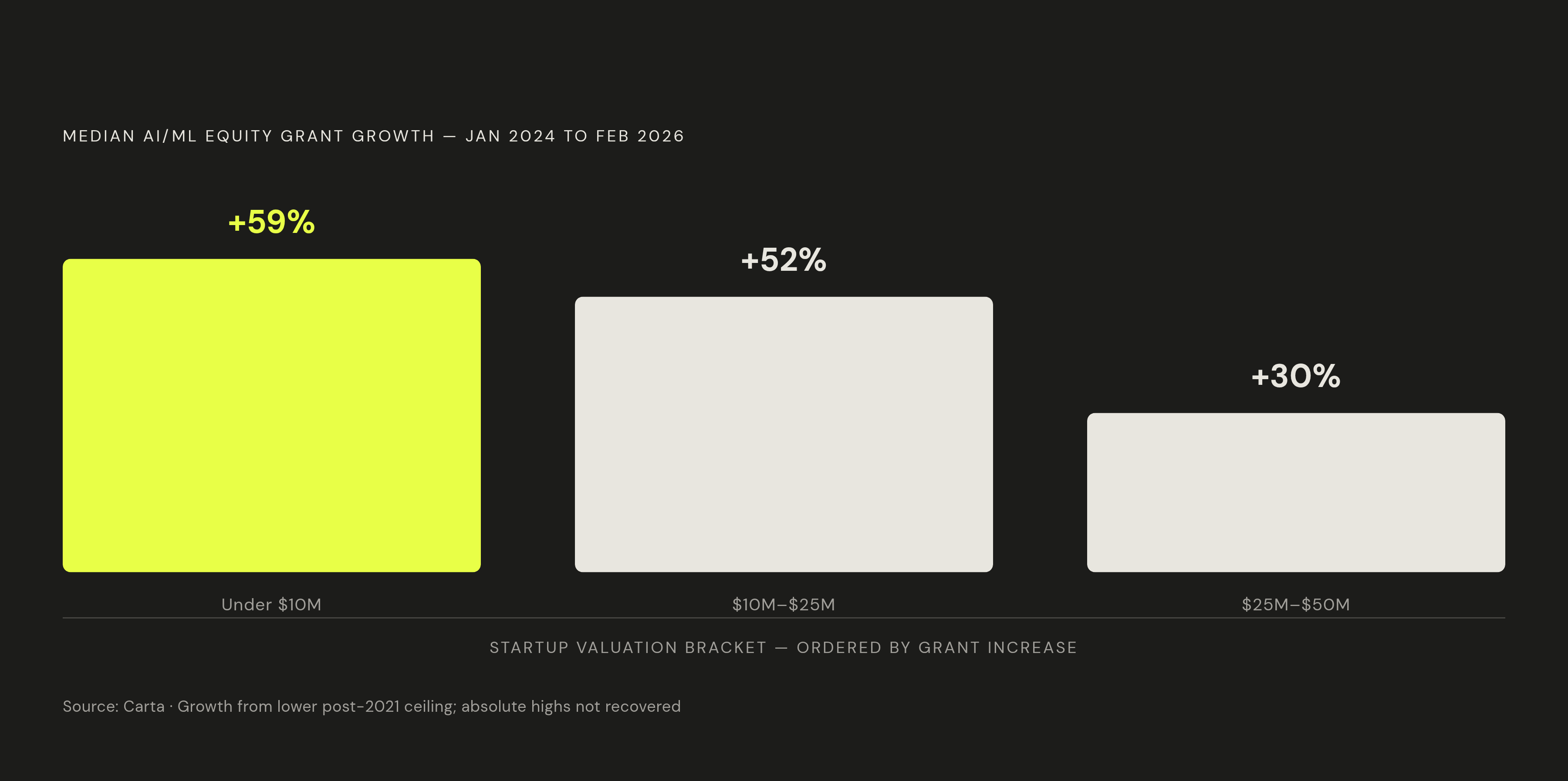
That said, the trend line on grant size itself is pointing up, even as the ceiling has come down. Carta's compensation data shows that for startups valued between $25 million and $50 million, median equity grant size for AI and ML engineers rose 30% between January 2024 and February 2026. Smaller valuation brackets saw even bigger jumps, 59% and 52% respectively. So while the absolute top-end numbers from 2021 aren't coming back, the typical grant at this stage has been getting larger, not smaller, over the past two years.
At the high end of the startup spectrum, the numbers look different again. Carta's data shows that at an AI-native startup valued above $500 million, an AI/ML engineer paid at the 80th to 95th percentile earns $320,000 in annual salary and receives a grant of 0.146% of total company equity. That's a small slice of the company in percentage terms, but it sits on top of a salary that's already competitive with much larger, more established employers.
What closes offers at this level is a straight conversation about dilution, current valuation, and realistic exit scenarios. A candidate weighing a startup equity grant against a frontier lab's RSU package deserves the real math on both sides, not a sales pitch dressed up as transparency.
The full offer package and negotiable variables
Everything in the sections above exists to answer one question: where does this specific offer actually sit inside the structure. Once an engineer knows the company's stage, their own level, the specialty their work actually falls under, and whether their production AI experience is priced into the band, they can tell which parts of an offer are fixed by the market and which parts are open to a real conversation.
Stage and level are mostly structural. They set the outer boundaries of what a company can offer without breaking its own internal pay logic. Inside those boundaries, plenty of room exists to negotiate: signing bonus, the size and vesting schedule of the equity grant, start date, even things like compute budget or dedicated research time at AI-focused companies. Knowing which of these is fixed and which is discretionary is what lets an engineer push on the right lever without putting the whole offer at risk.
The single strongest lever in this market is a competing offer. Recruits Lab's AI Hiring Report found that the majority of accepted offers face a counter before they're signed. Most engineers who accept an offer without bringing a competing one to the table are leaving real money on the table, money that was available simply for asking the question with leverage in hand.
