Signing Bonus Negotiation Tactics for Engineers Leaving Unvested Equity
How to price your forfeited equity and get a recruiter to cover it.

Summary
How to price your forfeited equity and get a recruiter to cover it.
Leaving unvested equity behind is a negotiation problem. For engineers, a signing bonus is the most reliable lever for recovering that loss because it is often easier to move than base salary or equity. But the deal only works if you calculate the gap, ask for a specific financial bridge, and check what you would owe back before signing.
Why engineers leaving mid-cycle forfeit more than they expect
A four-year vesting schedule makes departure timing expensive. Under a standard schedule with a one-year cliff, an engineer leaving at the 18-month mark gives up the equity scheduled to vest over the remaining 30 months. It is a set of scheduled grants you can identify before resigning, even though their eventual value may change.
The bonus and vesting clocks run on different schedules. Leaving before an annual bonus payout can mean forfeiting cash as well as equity, so a departure date that looks sensible against one schedule may be costly against the other. At AI labs and high-growth companies, equity can make up most of the total compensation. For a senior engineer, even six months of unvested equity can be worth a six-figure sum. Treating that loss as a footnote makes it easy to underprice the move.
How to calculate the exact dollar amount you are leaving behind
Start with your vesting schedule. Calculate the value of the RSUs or options you would forfeit over the next 6, 12, and 24 months if you left now. Keep those as three separate figures. Each window gives you a different anchor, so you can choose the period that is most defensible in the negotiation.
Next, add any annual bonus you would lose by leaving before its payment date. Keep the bonus on its own line. An engineer with RSUs vesting in March and an annual bonus paying in January has two costs to write down. Combining them produces a single ask without hiding how it was calculated. The recruiter can then relay the amount and its basis to HR.
Benchmark that figure against Levels.fyi and comparable offers at your level. A documented gap can still be aggressive relative to what the target company typically pays. Prepare an ideal ask covering the full gap, or slightly more, and a fallback supported by the same calculation. Both numbers should have an explanation before the call begins.
Why the signing bonus is easier to move than base or equity
Base salary is within a band tied to level. Going above it creates internal pay compression and can raise concerns about whether the pay meets pay transparency laws in California, New York, and the EU. A signing bonus is different because it is a one-time expense outside the base band. The recruiter has a short justification for requesting it. The candidate is walking away from a documented amount of unvested RSUs.
That difference explains an otherwise frustrating exchange. A recruiter may refuse a permanent base increase, then return minutes later with a higher sign-on approved. The recurring commitment and the one-time payment face different internal constraints. Equity grants can also require Compensation Committee approval, while sign-ons are often the component recruiters have more room to move. Sign-ons remain subject to approval, especially at larger amounts, and offer a sensible place to focus.
How to frame the ask so the recruiter can say yes
The practical move is to wait for a written offer, then frame the sign-on as a financial bridge. The window before signing is when your leverage is highest. Express enthusiasm for the role and readiness to move forward, then name the $[X] in unvested equity vesting in [month] that joining in [month] would forfeit. End with a direct question. “Is there any flexibility to add a sign-on that bridges part of that gap?”
Adapt that wording to your voice. The structure does three useful things without turning the conversation into a confrontation. It leaves the base band alone, gives the recruiter a verifiable cost, and signals that resolving the gap could close the offer. If an upcoming bonus is also at stake, name both losses in the combined figure. Provide the equity statement or vesting schedule if the recruiter asks for support.
Then give the recruiter room to answer. Silence after the ask is better than immediately negotiating against yourself. If the recruiter says sign-ons are not normal, bring the conversation back to the documented forfeiture. If the counter covers only part of the gap, use your prepared fallback to judge it.
What signing bonuses actually look like across company types in 2026
There is no single useful sign-on range for engineers. Packages vary from mid-level through senior, staff, and principal, and may combine cash with RSUs. The company’s rules and the facts of the negotiation further limit what is possible. These are directional reference points.
Google offers competitive senior-level sign-ons with high negotiability through a budget separate from base and equity. Meta makes heavy use of large senior-level sign-ons to win candidates who have competing offers. Amazon pays large sign-ons across Year 1 and Year 2 to make up for its back-loaded RSU schedule. Its sign-on is especially negotiable and is where much of the negotiation moves.
Some companies require a different approach altogether. Netflix does not offer signing bonuses for standard hires, so base salary is where there is room to negotiate, though executive packages can differ. Snowflake usually does not pay sign-ons for most IC roles, so equity is the better place to ask for more. Coinbase allows a narrow exception to its no-negotiation policy for documented losses, with written proof required.
Other offers may leave room that is not visible initially. LinkedIn has offered sign-ons at Staff level, but unlocking one can require concrete leverage. Salesforce often omits them from initial offers, so ask explicitly. Its sign-ons offer flexibility and come with a one-year prorated clawback.
Databricks, Datadog, Palantir, Reddit, Robinhood, Stripe, Uber, Nvidia, and Airbnb handle sign-ons case by case. For these companies, documented forfeiture or a competing offer can make the sign-on the most movable cash component. The direction of your move also changes the calculation. When moving from public to private, discount illiquid equity in your decision and push for higher cash base and sign-on. When moving from private to public, ask about an RSU sign-on grant to bridge the unvested private equity.
How competing offers multiply signing bonus leverage
Without one, the internal case is that the candidate would lose compensation by joining. With one, the case also becomes a live closing problem. Another company is offering a concrete alternative at or above the band. That can move the sign-on toward the high end of the recruiter’s discretion.
Make the comparison specific to the component you want changed. Ask whether the company can match the competing offer’s sign-on at $X. Share enough detail to establish credibility, including total compensation, level, and company stage, without sending the offer letter PDF. Never invent an offer or inflate its terms. Recruiters can informally check numbers through their networks, and a false claim can collapse the negotiation.
Timing is what makes this leverage usable. Run two to three interview loops in parallel where possible, aiming for offers within a few business days of each other. Restarting a process after receiving an offer rarely helps because recruiters generally will not wait weeks. Without another offer, truthful late-stage interviews still show options. Vague threats to walk away do not.
What to know about taxes before you celebrate the gross number
The headline bonus is not the cash you receive. Signing bonuses are treated as supplemental income, and withholding leaves you with less cash to cover your loss. Factor that into the ask. At senior levels, a tax gross-up is negotiable, though not standard. Ask explicitly if the sign-on is the main way you are recovering lost equity.
Payment timing changes the practical benefit as well. A lump sum at the start and installments across Year 1 and Year 2 produce different cash flow and interact differently with repayment terms. An installment structure such as Amazon’s spreads the benefit across two years. Before counting on that cash, you also need to understand what happens if you owe it back.
Clawback clauses: what is standard, what is predatory, and what to negotiate
A clawback can turn a useful bridge into a debt. The standard to seek is prorated repayment over 12 months, triggered by voluntary resignation, with no repayment after a layoff or termination without cause. Compare that with an all-or-nothing obligation lasting 24 months and covering “termination for any reason.” Under that wording, losing the job could also leave you facing repayment. The amount alone does not tell you whether the offer is safe to accept.
You may receive only the net payment after withholding but be required to repay the entire pre-tax bonus. That mismatch can leave you owing more cash than originally arrived in your account. Address it explicitly before signing. Push for repayment of net rather than gross, or negotiate a tax gross-up on the sign-on itself.
The other terms are also worth negotiating directly. Ask to reduce a 24-month window to 12 months and add explicit pro-rata language if it is missing. Require a carve-out for involuntary termination, including layoffs and termination without cause. But an agreeable conversation with the recruiter is not the same as revised contract language.
State law can further constrain what the agreement allows. California’s AB 692, effective January 1, 2027, sets conditions for the sign-on exception, including a separate repayment document and at least 5 business days to consult an attorney. The window must not exceed 2 years, interest must not accrue, and repayment must be pro-rata. The clause must exclude involuntary termination, and the employee must have been offered the option to defer the bonus until the retention period ends. That exception covers sign-ons paid at the outset of employment and excludes retention bonuses.
Those conditions are not a substitute for legal review. Read the actual clawback document carefully and talk to an attorney when a large amount is at stake, especially where new state rules apply. If you are in California or New York, verify the agreement against the relevant law. Also get any remote-work arrangement in writing before signing. A verbal promise offers little clarity if circumstances change and leaving would trigger repayment.
The full sequence, end to end
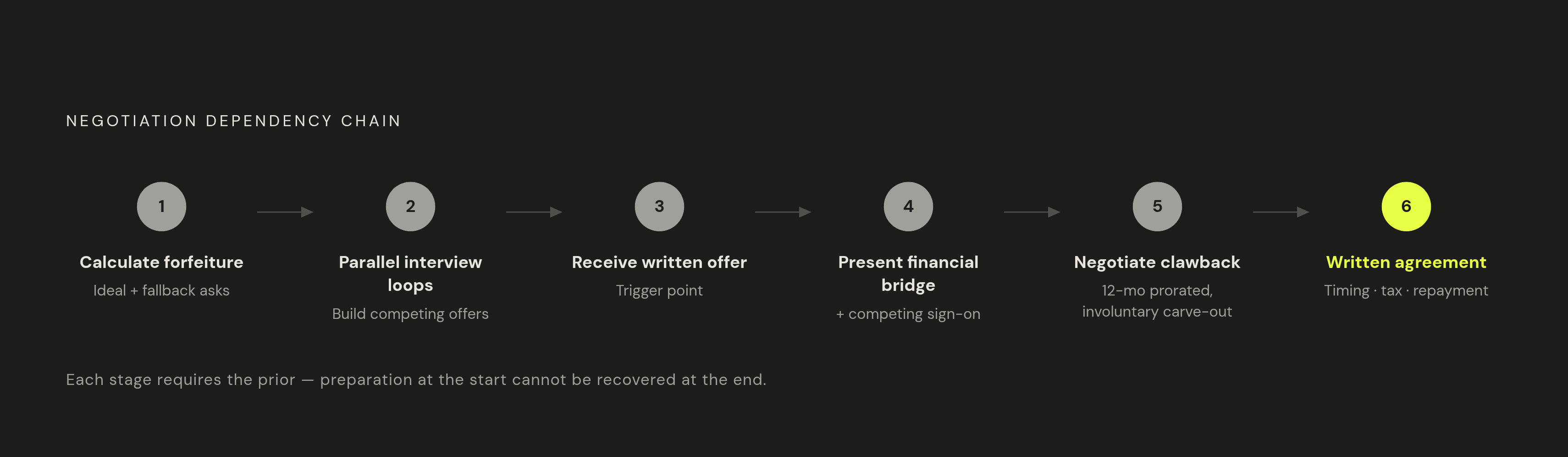
Begin with the evidence, move to the offer, and finish with the contract. Before the recruiter call, build your forfeiture calculation and choose your ideal and fallback asks. Once the written offer arrives, present the financial bridge and any specific competing sign-on to match. Before accepting, get written agreement on when you will be paid, how the payment will be taxed, and the repayment terms. Each step supplies what the next one needs, so speed at the end cannot make up for missing preparation.
A curated matching process can make this sequence easier when salary transparency and offer structure enter the conversation upfront. That way, both sides know what to expect before the offer letter lands, ahead of the final negotiation. The signing bonus is the most reliable lever for recovering lost equity only when the amount is defensible and the agreement lets you keep it on fair terms.


