Staff Engineer Salary Expectations at Growth-Stage Startups
Funding stage, equity structure.

Summary
Funding stage, equity structure.
Two engineers can carry the exact title "Staff Engineer" at two different growth-stage startups in 2026 and land hundreds of thousands of dollars apart in total compensation. The title itself explains almost none of that gap. What explains it is three separate variables, each invisible on a business card: the company's funding stage, the structure of the equity grant, and the base salary band that stage allows.
This spread reflects genuinely different jobs sitting under one label: different company stages, different equity structures, different levels of risk baked into the offer. A staff engineer at a 25-person Series A company and a staff engineer at a late-stage pre-IPO company are being asked to do different work, carry different scope, and absorb different amounts of financial risk. The title survived the transition; the job underneath it didn't.
Part of this traces back to what "staff" means as a promotion threshold. Staff is the first level where pay starts tracking the distance a decision travels through an organization, over how fast an engineer ships code. A senior engineer gets measured on execution. A staff engineer gets measured on how far their architectural choices, technical judgment, and cross-team influence reach. That scope shift, not tenure and not raw skill, is what the market is actually pricing. The rest of this piece works through the three levers that turn that scope into a dollar figure, and how to evaluate whether a given offer is sitting at the realistic end of the range or stretching past it.
How company stage sets the outer limits of a growth-stage startup's offer
Of the three levers that shape a staff engineer's compensation, stage is the least negotiable. Base salary can move. Equity percentage can move. The stage a company is at sets the walls those negotiations happen inside, and an engineer who benchmarks against the wrong stage is working from numbers that don't apply to the offer in front of them.
The pre-IPO tier runs from Series C through late stage, and it's the most complex and highest-paying point on the spectrum. In 2026, staff and principal engineers at these companies hit a high 90th-percentile ceiling on total compensation. Recruiting from Scratch's pre-IPO staff salary data names Veeam Software, Mercor, and Tenstorrent as the top payers establishing that realistic upper bound. Companies at earlier stages pay meaningfully less in cash, and they try to close that gap with a larger equity percentage, though whether that equity ever converts into real money depends entirely on how the company performs.
Three structural elements appear at the pre-IPO stage that earlier-stage offers typically don't have. An engineer who raises secondary liquidity programs or tender offers early in a negotiation gets a concrete, near-term equity value to work with instead of a number that only exists on paper, since some Series D+ companies run these programs. Most late-stage companies have also shifted from stock options to RSUs, which removes the exercise cost entirely but makes the gain-or-loss profile symmetric: no asymmetric option upside, but no strike price risk either. On top of both of those, annual refresh grants become part of the picture, and reading the true total comp number means accounting for the refresh schedule, not just the size of the initial grant.
If you're evaluating a pre-IPO offer, the stage sets the due-diligence agenda before you can even start on the equity math. Recruiting from Scratch's pre-IPO guide points to four variables that matter most: the 409A valuation against the last preferred round, the liquidation preference structure, the ARR trajectory, and whether the company has any tender offer history. For companies doing the hiring, a credible near-term path to liquidity is often the one lever that lets a late-stage startup win against public tech offers on total comp. Without that story, base salary has to carry more of the weight on its own.
What determines the base salary range at growth-stage startups
Base salary is the easiest of the three levers to anchor on, because it's the number candidates see first and compare across companies most directly. At Series B and C startups, Recruiting from Scratch's startup salary guide puts San Francisco Bay Area staff base meaningfully higher than the national range. Remote US-based staff base at the same companies runs somewhat lower than the SF equivalent. The remote gap exists, but it's shrinking: well-funded startups are increasingly willing to pay US national rates because the engineers they want won't relocate for a job, and the companies that insist on location-based pay cuts are losing those candidates to ones that don't.
A few things move base up within whatever band a given stage allows. Demonstrated ownership of critical system architecture counts for more than years of experience on a resume. Deep expertise in production machine learning, large-scale distributed systems, or high-performance computing commands a premium over a generalist staff role, because those specializations are scarcer and harder to backfill. AI and ML specialization in particular carries a real premium above baseline staff pay: Carta's compensation data shows AI-native companies paying more in both salary and equity than non-AI companies at the same valuation. That AI premium matters more on the equity side than the base side, and the next section covers why.
Base also gets suppressed in predictable ways. Taking a founding engineer seat is the clearest example: engineers in those roles commonly trade cash for equity, and the median founding engineer base sits slightly below the median senior software engineer base. That's not a mistake on the company's part. Early-stage companies are conserving runway, and founding engineer compensation is built around that constraint from the start.
When you evaluate an offer, keep base and total comp as separate numbers. Base tells an engineer what shows up in a paycheck every two weeks. It says nothing about what the equity is actually worth, and that's where growth-stage offers either hold up or fall apart.
How equity structure determines whether a total comp number is realistic or a stretch
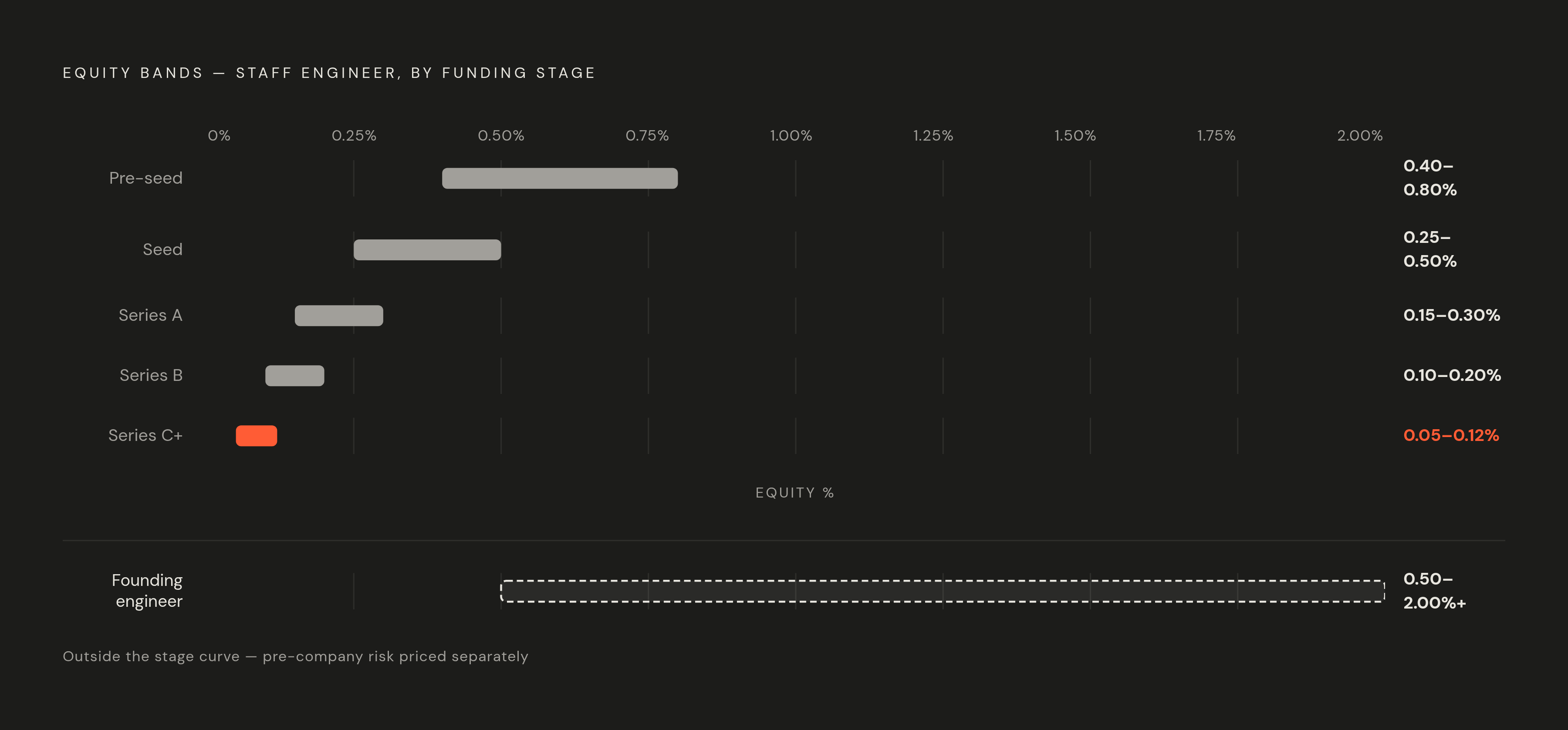
Equity is the line that decides whether a staff engineer offer closes or dies at a growth-stage startup. It's the mechanism that turns a total comp number into something real, or leaves it as a number that only works on a slide deck.
Equity percentage expectations for a staff engineer with 8 to 12 years of experience follow a clear curve by stage:
- Pre-seed: 0.40%–0.80%
- Seed: 0.25%–0.50%
- Series A: 0.15%–0.30%
- Series B: 0.10%–0.20%
- Series C and later: 0.05%–0.12%
Founding engineer roles sit outside that curve. One of the first one to five engineers at a company typically receives 0.5% to 2% or more, and that gap is the reason founding engineer offers need their own evaluation logic instead of being compared against standard staff bands.
AI-native startups are granting noticeably more equity than non-AI startups at the same valuation, and Carta's AI compensation analysis shows that gap is not marginal. This gap appears clearly in grant sizes at earlier-stage companies: an AI-native Series A offer can carry equity sized closer to what a non-AI company might offer at seed.
The most common reason engineering offers get turned down at startups isn't the cash number. Recruiting from Scratch's placement data points to an incomplete or evasive equity conversation as the top reason candidates walk away. That's fixable, so fix it by asking for specific information before you sign anything:
- Fully diluted share count and the conversion price at the 409A valuation
- The liquidation preference structure on outstanding preferred shares, which can make common stock nearly worthless at a modest exit even when the nominal percentage looks large
- Whether annual refresh grants are guaranteed or left to company discretion
- Secondary market or tender offer history at Series D+ companies
An engineer should treat these four items as the actual negotiation, not paperwork to review after accepting an offer. If you've been through a startup outcome before, vague optimism about equity upside won't close you. Specificity about liquidation preferences and the preference stack does, because engineers who've watched a preference stack wipe out their own grant at a previous company aren't taking anyone's narrative on faith anymore.
Why title-to-title comparisons across companies require a translation step
Engineering titles don't carry the same meaning from one company to the next, and plugging a salary number into the wrong title produces a benchmark that's off by a full level in either direction. Before any compensation math makes sense, the title has to get translated first.
A few mappings account for most of the confusion. At Google, L6 is the standard staff benchmark, while L5 is senior. At Meta, E6 is the staff equivalent, but Meta weights comp more heavily toward equity, so the total comp picture looks different from Google's even at matching levels. At Amazon, L7 is staff, but L6 is SDE III, also called Senior SDE. A recruiter quoting "Amazon L6 staff pay" has down-leveled the benchmark by a full tier without realizing it. Microsoft titles its staff-equivalent band as Principal, spanning L65 to L67, while L63 to L64 is senior.
Startups add another layer on top of that big-tech matrix. A senior engineer at Meta, at the E5 level, typically maps to a senior role at a scale-up like Stripe or Databricks. That same engineer maps to principal or founding engineer at a startup with fewer than 30 people. Total cash compensation drops materially as company size shrinks along that path, and the gap gets made up, at least on paper, in equity.
Title inflation is especially acute at small startups. Companies with fewer than 300 engineers typically don't have a real leveling ladder in their first few years of existence. "Staff" at a 30-person company often just means the most senior engineer who wasn't a founder, and that role carries founding-engineer equity logic, not the large-company staff equity logic an engineer might expect from the title alone. Before accepting or rejecting any comp number, the real question is staff at what kind of company, doing what archetype of job. The title is the least reliable input available, and treating it as reliable is where most benchmarking errors start, including the one that separates staff from principal.
Where staff compensation ends and principal compensation begins
The jump from staff to principal is a change in scope, from owning a system or a cross-team initiative to owning a company's technical direction, and the compensation gap reflects that change directly. Principal total comp tends to start roughly where staff total comp ends.
At well-funded startups and larger public tech companies, Recruiting from Scratch's staff vs. principal comparison shows staff engineer total comp reaching a meaningful ceiling, with principal total comp at the same companies going meaningfully higher past that point. Principal roles are also structurally rare. The same source finds roughly one principal opening for every three to four staff openings in current active sourcing data. That scarcity is itself part of why the compensation jump exists: fewer seats, more competition for them, higher pay to match.
Scope is what separates the two roles in practice. A staff engineer owns a critical system or a set of services inside a larger domain. Impact crosses teams but usually stays within one organizational slice, and the work stays hands-on: architecture decisions, paired with building consensus across the people affected by them. A principal engineer operates at a different altitude entirely, working across multiple product areas or the whole company at once. Code contribution shrinks to a minimum. The value a principal brings comes from foresight, from writing architectural proposals that shape future direction, and from influencing decisions that affect the product at a scale no single staff engineer's system touches.
At an AI startup specifically, you can expect strong total comp as a staff engineer, within the ranges already described. A principal engineer at that same type of company typically commands $450,000 to $850,000, with a larger share of that number tied to high-risk, founder-level equity. The gap between those two figures is the clearest illustration of what scope is actually worth once it expands past a single system and starts touching the whole company.
What engineers who negotiate well do differently when evaluating a growth-stage offer
Engineers who land at the top of the growth-stage range don't treat negotiation as pushing on one number. They treat it as three connected levers, stage ceiling, base anchor, and equity structure, where movement on any one of them changes what's possible on the other two. A company that can't move base because of its stage might have room to move the equity percentage or the refresh schedule instead.
Remote candidates should push explicitly for location-agnostic pay. A meaningful minority of well-funded startups still pay a flat, top-of-market number regardless of where an engineer lives, and candidates who don't ask for it generally don't get it. Recruiting from Scratch's startup salary guide notes that this practice is becoming rarer, which makes asking for it early in the process more important, not less.
Equity is where most money gets left on the table, and the fix is procedural: get the fully diluted share count, the 409A valuation, and the liquidation preference structure in writing before signing, not after. At AI-native startups, milestone-based equity refresh terms are a live negotiating point in the room, not a vague future promise to take at face value. At pre-IPO companies, ask directly whether secondary liquidity programs exist and whether the company has any tender offer history. That answer changes the real risk profile of the equity component in a way that the headline grant number never shows on its own.
The strongest resistance to pushing hard on equity comes from engineers who've been burned before, and that resistance is earned. A company that narrates its equity upside with real specifics, backed by actual numbers on valuation and preference stacks, can close top candidates even when its cash offer sits below benchmark. If engineers have already lived through a startup outcome where the preference stack left their grant worth nothing, vague optimism about future upside won't work on them.
Title level is worth fighting for before an offer gets finalized, not after. Getting leveled correctly, staff versus senior, or principal versus staff, matters most at companies where those levels carry distinct pay bands and distinct refresh schedules. That distinction compounds over the life of the role through every future refresh grant, every bonus target, and every promotion threshold that gets measured against the starting level. Engineers who get found and referred into these conversations, rather than applying cold, tend to walk in with more context on a company's real comp philosophy, where the company sits in its search, and what competing offers look like. That context is what separates a strong negotiation from a blind one, and it's the difference between landing inside the realistic range this piece has laid out and landing somewhere far below it.