Wellfound Versus Fonzi for Engineers Seeking AI Startup Roles
Fonzi refers screened engineers, while Wellfound leaves the searching to you.

Summary
Fonzi refers screened engineers, while Wellfound leaves the searching to you.
Fonzi is the stronger starting point for engineers with demonstrated AI skills who want to be recruited into startup roles. Wellfound works well for engineers who want to look widely and choose every company they contact. One screens and refers candidates, while the other gives them an open marketplace to navigate themselves.
Why the AI startup hiring market in 2026 rewards engineers who understand platform structure
AI engineering demand in 2026 concentrates in three areas. Applied AI engineers ship LLM-backed product features end to end. ML engineers take models from notebooks to inference at scale, while infrastructure engineers run the systems used for training and serving. Generalists without a clear specialization face filtering at the resume stage. A broad profile can be passed over before anyone looks at the work behind it.
That makes platform choice part of how an engineer’s skills reach an employer. A marketplace puts the burden on candidates to make their specialization legible across applications. A referral system checks that work before putting candidates in front of companies. Speed also changes the stakes of that distinction. Strong candidates leave open processes quickly, and a slow route to a decision can cost an engineer an offer.
What Wellfound actually is and how its self-serve model works
Wellfound is a self-serve marketplace where engineers make profiles, search listings, and apply straight to companies. Its free tier surfaces candidates to companies that choose whether to respond rather than screening, matching, and referring them. Access is open and free for engineers. Creating a profile, applying to unlimited roles, and receiving inbound company messages cost nothing. That makes it a practical place to explore without committing to a narrow search.
Its AI engineer listings show thousands of active results, from seed-stage businesses to large enterprises, with a wide range of pay. Job cards show salary ranges and equity percentages where companies have shared them. Compensation is visible before a conversation begins. Cards also show company stage, headcount, investor quality indicators, and response-rate badges, giving candidates context before they click through. Remote roles run into the thousands, although many require US time-zone overlap or availability in particular states.
Those features support an engineer-led search, but they do not replace one. Filtering, applying, and following up remain the candidate’s work. Screening, curated referrals, and services intended to shorten the path to a decision belong to the platform’s paid Curated and Autopilot add-ons. The distinction is important when comparing the open marketplace with a service built around referrals.
What the Wellfound listing feed actually contains, and what that means for a serious AI engineer
The feed contains credible AI product roles. The feed has roles such as AssemblyAI’s Enterprise Applied AI Engineer, Monte Carlo’s Applied AI Engineer with remote US availability, Pulley’s Applied AI Engineer in San Francisco, and Doss’s Founding Applied AI Engineer in San Francisco. These are useful leads for a focused search. They also cover different kinds of work and different constraints, so their presence alone does not make them interchangeable targets.
The same feed also has large government contractors and digital services firms, along with early-stage companies whose pay ranges are below market. An engineer looking for seed-to-Series-B AI product companies has to sort those out from the employers they want to reach. The inventory is broad. The shortlist is personal. Even among plausible matches, equity disclosure varies from precise percentages to broad or nominal ranges, with some listings omitting it entirely. So an engineer may need to look beyond the card to compare roles.
Response-rate badges help with sorting employers, but only up to a point. They offer a rough indication of how quickly a company replies. A fast first response can still lead into a six-week process.
What Fonzi is and how its invitation-driven model works differently
An invitation-driven model reverses the application process by screening engineers, matching them to companies, and delivering interview requests with salary bids upfront. The engineer receives an invitation rather than entering an application queue. That changes who does the initial sorting. Instead of asking candidates to identify every plausible opening and persuade each employer separately, the service recommends screened engineers to matched companies. Its focus is AI startups and high-growth tech companies.
The AI talent agent is accessible through iMessage, a web portal, or a Claude Code MCP integration. These are different ways to interact with the same referral-led model. The agent screens engineers and recommends them to companies. When an interview request comes back, the compensation bid is already stated. That gives the candidate a concrete pay signal before entering the process, rather than leaving that question unresolved until late in the interviews.
Companies search for what engineers can do. For example, an employer can look for someone who has fine-tuned large models on specific hardware or run LLM eval pipelines at scale. Those distinctions are narrower than an “AI engineer” title. They connect the search to work an engineer has done, which is especially relevant when a broad title conceals very different technical strengths. The model is designed to spare candidates the repeated work of searching, applying, and following up into silence.
The intended candidates include former startup or big-tech engineers who want to return to startups, strong juniors with high-bar public work, and engineers already at startups who are quietly open to another role. They all have work that shows what they can do. The service is built for people who code outside work and have firm views about what separates a well-run organization from a mediocre one. For those candidates, finding a suitable team is a more precise task than finding any opening.
The structural difference that determines which platform fits which engineer
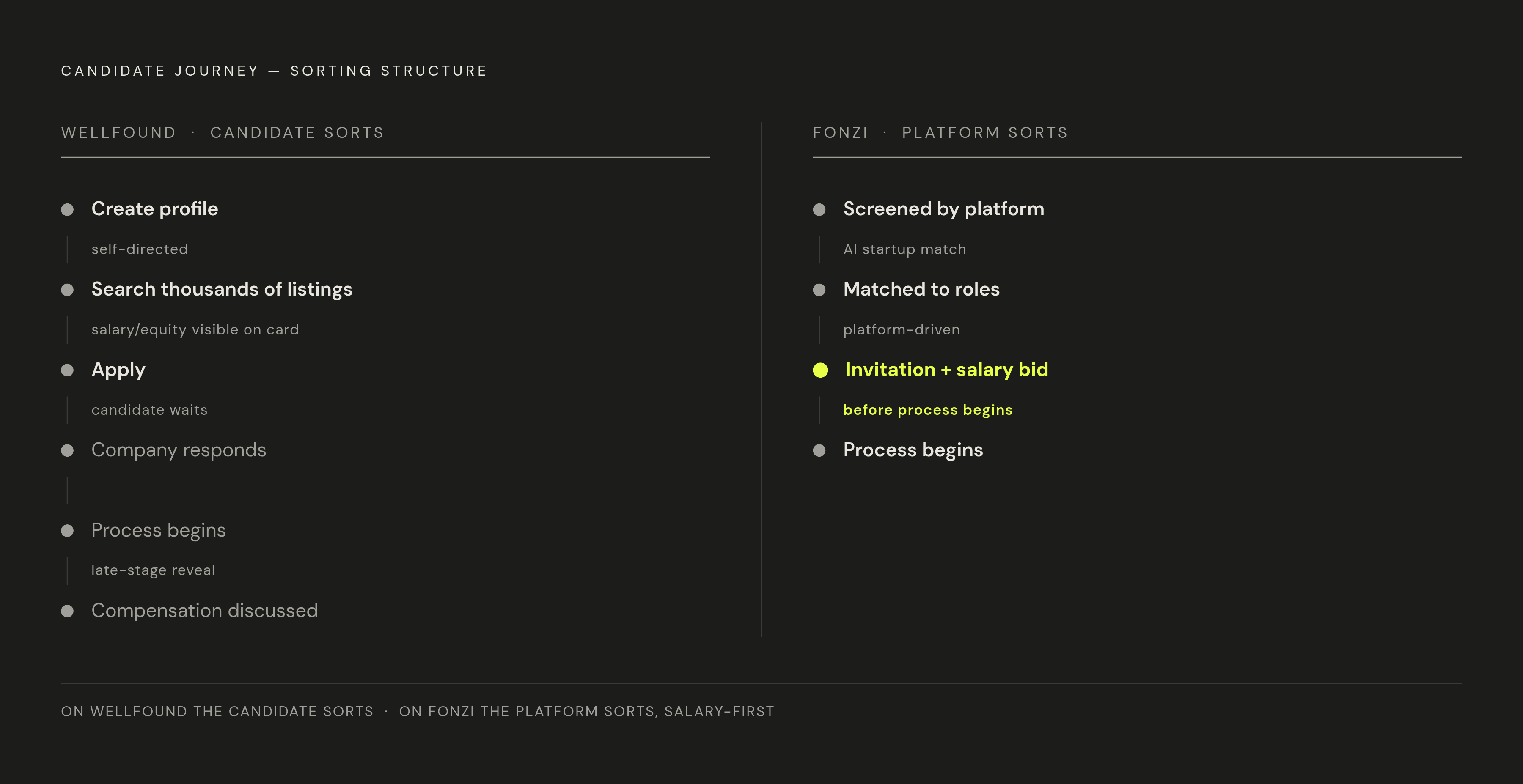
The decision turns on how much control an engineer wants and how much search work they want to do. Wellfound is a good choice for a candidate who wants to choose every company, look widely, and see salary and equity before getting in touch. Open access is its practical advantage here. The engineer can pursue a role without first clearing a separate curation bar, provided they are willing to handle the filtering themselves.
The referral model fits an engineer who has strong work to show and wants a role at an AI startup without spending evenings sorting listings. A salary bid attached to an interview request is different from a published pay range. One accompanies an invitation to speak. The other helps someone decide whether to apply. Engineers still need to check the employer with either model, but how much work they do before the first conversation differs.
The referral model has a real access constraint. An engineer whose profile does not clear the screening bar may not be matched, making the open marketplace the more practical starting point. Years of work alone do not decide who clears that bar, because a junior engineer can qualify through high-bar public work. Founding engineer roles sharpen the distinction further. These high-equity, high-autonomy seed-stage hires often close from short lists of pre-vetted candidates, many of whom were not actively searching when the opportunity arrived.
What AI startup interview processes actually look like, regardless of which platform gets you in the door
A typical early-stage AI startup loop includes a multi-hour take-home that asks the candidate to build a small AI feature to spec, followed by a review defending the trade-offs. Before that usually comes a hiring manager or founder screen about fit and whether the engineer has shipped AI features. The work is central to the assessment. Most early-stage loops in 2026 do not follow the standard FAANG algorithmic sequence, though AI startups that are later-stage or hardware-focused may still have algorithmic coding rounds.
For a founding engineer, the company may present its actual AI problem and ask for a proof-of-concept architecture. The discussion can cover the RAG design, how quality gets measured, what the eval dataset looks like, and the cost per query. These choices expose more than coding fluency. They show whether a candidate can turn an ambiguous problem into a system worth prototyping and eventually putting into production. Monte Carlo’s Senior AI Engineer role description states the expectation plainly as “You'd get the problem, not the spec”.
Preparation requires practicing that whole path beyond algorithm drills. Research, prototyping, production judgment, and the ability to explain decisions all belong in the frame. AI literacy is part of the technical bar. Interviewers assess how candidates frame prompts, evaluate generated code, debug incorrect suggestions, and integrate AI into a broader solution. Getting referred changes the route into that assessment while leaving the work required to pass it unchanged.
How to read a Wellfound listing for the signals that matter before applying
For engineers using the open marketplace, the practical task is to read the card as evidence. “Scale Stage” with named top investors indicates a company that has cleared early funding risk, while “Early Stage” without an investor badge calls for more due diligence. Those labels describe context. They help engineers decide how much to look into a company before an interview.
A company near the top of responders with a fresh listing gives a reasonable signal that the role is live and the process active. Neither clue is enough on its own. Pay needs the same kind of reading, with salary, equity, and level looked at together. Negligible equity on a non-senior role, or “No equity” at a growth-stage company, is a concern to flag before applying. A very wide salary range at one level may reflect uncertainty about leveling and is worth probing in the screen.
Location language needs a second read as well. “Onsite or remote” is not the same as “Remote only” or “Remote • United States”. The first may mean travel from time to time or a move later on, while a US label clearly limits where someone can work. A remote label does not settle eligibility. The fuller description may still impose state restrictions or time-zone overlap, so the headline alone is not enough to establish whether a role fits.
Which platform to lead with, and how to use both without wasting time
For an engineer with demonstrated work who is specifically targeting AI startups, the referral-led model is the stronger default. Curated referral platforms are often built for top ML and software engineers headed to AI startups, with a large pool of profiles reviewed to keep the cohort tight. That positioning makes screening an access condition. Engineers who fit the candidate profile can start through a messaging app or a web portal. Someone who has a job and is moving carefully can get matched invitations without also having to keep a separate set of applications going.
Wellfound remains a useful complement. Its salary and equity disclosures across thousands of live listings provide benchmarks for evaluating an offer, even when the introduction came through another route. Discovery and compensation research are legitimate uses on their own. An engineer can look at the wider market while waiting for matches without applying to every role that looks interesting. Earlier-career candidates without a strong public work signal, or anyone still exploring broadly, can instead make its free access and stage, role, and remote filters their primary channel.
Start with the referral route because those hires tend to close from short, pre-vetted lists. If no match surfaces, use the open marketplace to identify companies worth approaching independently.