San Francisco vs. New York Engineer Salary Differences
Base pay has converged, so equity, taxes, and role type decide.

Summary
Base pay has converged, so equity, taxes, and role type decide.
San Francisco no longer pays software engineers a meaningful premium over New York at the individual-contributor level. Base salaries between the two cities have converged to within a few percentage points. The old assumption has quietly collapsed, and the real differences now sit in equity structure, taxes, and role type.
For at least a decade, SF's dominance in IC base pay was treated as structural. The logic was simple: FAANG concentration plus venture capital density created a labor market where base salaries ran higher than anywhere else, and New York was a finance town that happened to employ some engineers. That held for a long time. Over the last three years, it stopped holding.
The strongest objection to this argument is easy to predict: SF still pays more on Levels.fyi. And it does, at the headline level. But the raw number misses most of the story. Base has converged. Total comp has not. Taxes, equity liquidity, and role type now shift the comparison more than the city itself does.
How base salaries compare at each IC level right now
At the IC level, SF and NYC base salaries have converged to within a few percentage points. The gap varies by role and seniority, and those variations matter more than the old city premium ever did. The spread across salary sources is itself useful data: it reflects what different kinds of employers are actually paying, not a contradiction to be explained away.
The mechanism behind convergence is straightforward. NYC's finance and fintech sectors have been bidding IC bases up through direct competition. Hedge funds, investment banks, and AI-native fintech companies need senior engineers, and they pay in cash because their comp is built around bonus and base rather than equity. SF pay, by contrast, is governed by equity-loaded Big Tech packages where base salaries are deliberately compressed. A base salary in SF is only one part of a package that leans heavily on RSUs and options. Base and base are now close. Equity and equity are not.
Where the SF premium survives: equity and total compensation
Once equity is included, SF still leads materially. The premium is equity-driven, not base-driven. Conflating the two is the most common mistake engineers make when comparing offers.
The pattern shows up clearly in AI/ML roles. 2026 data corroborates that gap: NYC mid-level AI/ML total comp trails SF. The reason is structural. The Bay Area captured far more venture capital in 2025 than NYC did, and that capital concentration sets the ceiling on early-stage equity upside. Pre-IPO equity from a well-funded SF startup is more likely to become liquid and valuable. NYC equity packages tend to be smaller grants at more mature companies or financial institutions, where equity takes the form of RSUs with a clearer but lower ceiling.
Fonzi's editorial on how to read equity in startup packages walks through this exact split. The probabilistic value of early-stage VC-backed grants behaves differently from the certain floor of a base salary, and the calculation shifts depending on whether the role sits at a well-funded Bay Area startup or an RSU-heavy mature firm in New York. Equity is probabilistic. Base is certain. Engineers with shorter time horizons or real risk aversion should weight the two differently than those optimizing for long-run upside. But even the equity premium gets partially clawed back. The next section explains how.
What the pay gap actually means in take-home income after taxes
NYC's combined state-plus-city income tax is the single biggest factor most engineers underestimate when comparing offers. It narrows the effective gap between the two cities more than any salary negotiation can. The numbers make this concrete. An SF engineer's higher gross pay translates to a net take-home advantage of roughly $19,000 per year. That is real money. It is also considerably smaller than the gross gap implies. Seattle is the relevant counter-case here, though it is not this article's focus: an engineer there keeps materially more of a lower gross number because there is no state income tax. New York has no such relief.
The mid-level picture is the most sobering. At senior levels, SF still wins on purchasing power, but by less than gross pay suggests. At mid-levels, the after-tax gap can nearly disappear. When engineers in SF and NYC benchmark their actual net income after state and city taxes, the gross salary advantage narrows more sharply than most negotiation guides acknowledge. Recruiting platforms like Fonzi surface this early, because understanding true take-home is often what tips a decision between two offers that look equivalent on the offer letter.
This is the point where the comparison gets genuinely strange. At the IC level, the cities have converged. At the management level, they invert.
The one role where NYC pays more than SF: Engineering Manager compensation
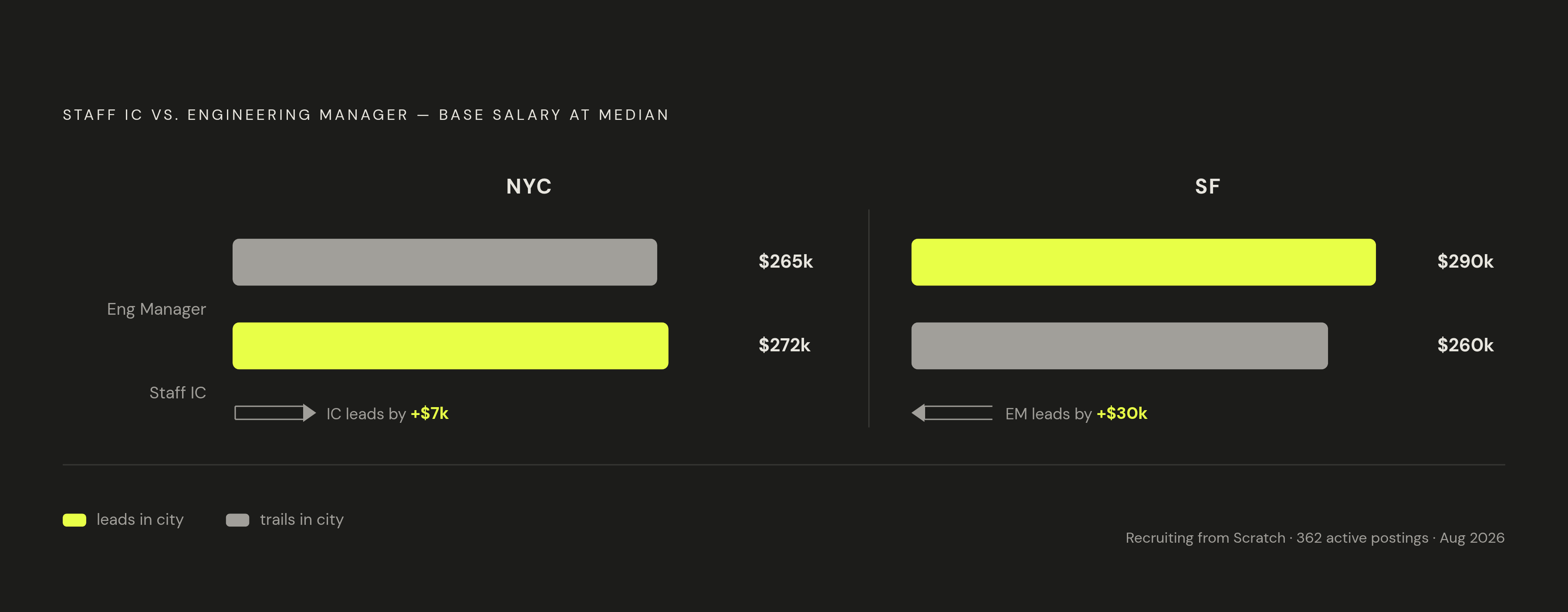
The management premium reverses between cities. That is the sharpest structural inversion in the data, and it breaks any remaining assumption that SF uniformly leads. Recruiting from Scratch measured 362 active US engineering postings with disclosed base salaries in August 2026. SF's median Engineering Manager base came in 9.4% higher than NYC's, the widest gap of any senior role they track. But the real story sits one level below. In NYC, the Staff IC earns slightly more than the EM at the median. In SF, the EM out-earns the Staff IC by a meaningful margin. The management track is a raise in one city and not in the other.
The mechanism explains itself. NYC's senior IC market is supply-constrained. AI and fintech employers are bidding up Staff IC bases, while the EM market is better supplied there. SF has the reverse problem: a deep bench of senior ICs and a genuine scarcity of people who have managed teams through scale. Engineers in each city navigate this difference when deciding between tracks, and Fonzi's community events in both SF and NYC surface the question regularly. For startups, the consequence is direct. In NYC, you can often hire a strong EM for less than a strong Staff IC, which should shape headcount planning and band-setting. One more variable changes the comparison in both cities at once: AI specialization.
How AI and ML roles change the comparison in both cities
AI and ML specialization commands a premium in both SF and NYC that is large enough to matter more than the city gap. The more interesting difference is the type of AI work each city generates, because that shapes what an engineer's resume looks like five years later. NYC's AI market skews toward deployment inside regulated businesses. Engineers there work on LLM applications, fraud models, risk systems, personalization, and automation inside finance, insurance, and healthcare. JPMorgan's Data & AI organization is the emblematic example, and Jamie Dimon has said the bank expects to hire more AI specialists and fewer bankers in certain categories. SF attracts researchers and infrastructure builders instead. Neither is superior. The career paths and comp structures simply diverge over time.
The distinction is already blurring. Anthropic signed an entire building at 330 Hudson Street in New York in July 2026, so even the SF-native frontier AI labs are planting serious NYC footprints. The research-versus-deployment split between the two cities may not hold for much longer. For now, what matters is that an AI/ML engineer in either city earns a premium on top of the local market rate, and the kind of AI work available differs enough to shape a career. The same dynamics shift again at the earliest stage.
What founding engineer and early-stage startup compensation looks like in each city
Founding engineer pay has nearly converged between SF and NYC on base salary. Equity grants remain slightly larger in SF on average, a gap explained by the same VC capital concentration that determines how meaningful that equity is likely to become. Recruits Lab's 2026 founding engineer guide puts US founding engineer base salary at $180,000 to $340,000, with equity depending on stage. Pre-seed founding engineers typically earn lower bases and higher equity percentages. Seed founding engineers earn mid-range bases with moderate equity. Series A founding engineers earn the highest bases with the tightest equity grants. The same source shows NYC founding engineers largely closed the base salary gap with SF as of 2025, though equity grants run slightly lower on average.
That equity difference matters more in SF because the ceiling on early-stage equity outcomes is higher there. The Bay Area captured far more venture capital in 2025 than NYC, and that ratio determines how likely a grant is to turn into something real. Engineers who prioritize base certainty over equity upside now find NYC founding roles genuinely competitive. Engineers optimizing for long-run equity outcomes still see structurally higher expected value in SF's startup ecosystem, along with higher variance and a denser network of people who have done it before. A founding role in NYC often means a more diversified economy and a lower-risk equity story. Those are different assets, not better or worse ones.
How remote and hybrid work policies are reshaping the comparison from the outside
The remote option has not equalized pay across cities the way engineers hoped. Hub-and-spoke discount bands are now standard, and SF is actively pulling AI roles back into the office faster than any other market. Remote job postings in the Bay Area fell to 7% in April 2026, down from roughly a quarter in mid-2022. Across all US tech talent postings, the remote share is considerably higher. The AI boom is physically recentralizing SF's labor market. Companies now adjust remote pay meaningfully downward for engineers outside their primary hub cities. A role paying at SF rates in SF pays considerably less for the same work done remotely.
Three remote pay models exist, and engineers need to know which one applies before comparing to an in-office offer. Location-agnostic pay gives the same salary everywhere and is common at smaller or newer companies. Region-banded pay is the most common model at large employers. Local-market pay triggers a salary recalculation when you move cities. NYC's remote posture is more flexible than SF's in 2026, which matters for engineers who want access to NYC-caliber employers without committing to the full cost of living. The tax picture for remote workers based in New York State is equally demanding, though. And the in-office pull in SF hits AI/ML engineers hardest, since those are the roles being recentralized fastest. That brings the comparison to a decision.
A practical framework for comparing an SF offer against a NYC offer
Comparing an SF offer to a NYC offer means working through five variables in sequence: role type, total comp structure, effective tax rate, cost of housing, and equity realism. The order matters, because the earlier variables constrain how much the later ones matter. Start with role type. If the role is Engineering Manager, SF leads by a significant margin. If it is IC, the base gap is small and total comp becomes the deciding factor. If it is AI/ML specialist, the city premium is secondary to the specialization premium, which applies in both cities.
Then look at total comp structure. Strip equity out and compare base plus bonus. Then add equity back at a realistic discount. Pre-seed equity in SF is not worth face value. Public RSUs at a fintech in NYC are near-liquid. The actual expected value of each package may invert the nominal comparison.
Then run the tax math. NYC's combined state-plus-city income tax costs a senior engineer a meaningful amount per year relative to California. 2026 data puts the effective tax rate for a Senior Engineer in New York City at 40.2%. Model the after-tax number before accepting a nominal parity argument.
Then factor housing. NYC's median rent for a comparable apartment runs above SF's, which partially offsets the tax disadvantage. Engineers with families, rent-controlled apartments, or longer time horizons in one city need to factor transition costs, not just steady-state costs.
Finally, test equity realism. Ask the stage, the last round valuation, the VC pedigree, and whether the company has a path to liquidity. Equity from a pre-seed SF startup and RSUs from a Series D NYC fintech are not the same asset class.
If you want to compare live offers across both markets without running every step manually, you can work with Fonzi. Its AI talent agent matches engineers to AI startups and high-growth companies in both SF and NYC, surfaces salary bids upfront, and compresses the offer timeline so engineers compare real numbers rather than estimating from benchmarks. Staying in an open process too long risks losing the best offers, which is the core problem Fonzi is designed to solve.