Robotics Engineer Salary Benchmarks at Hardware AI Startups
Pay depends on employer tier, specialty, and city, not one average.

Summary
Pay depends on employer tier, specialty, and city, not one average.
Robotics engineer salary benchmarks at hardware AI startups only make sense when they match the job. In 2026, pay markets differ by employer tier, technical specialty, and where the job is. Engineers who negotiate from a broad average leave money on the table. The useful benchmark is what employers competing for their particular skills will pay, with startup equity evaluated separately from cash.
Why the "robotics engineer salary" question has no single answer
One title hides several kinds of work. “Robotics engineer” covers at least six tracks, including ROS platform engineering, motion planning and manipulation, robot perception, controls and whole-body control, robot learning and VLA, and mechatronics and hardware. Their daily work barely overlaps. Yet a headline salary number blends those tracks together, misleading candidates about their leverage and hiring teams about the budget a role needs.
The BLS groups robotics engineer jobs into SOC 17-2199, Engineers, All Other, which also includes lower-paying automation, agricultural, and marine engineering titles. That makes the category useful as a floor and a geographic signal.
How the humanoid boom reshaped the entire compensation landscape since 2024
The humanoid boom has tightened the supply of experienced robotics engineers across employer tiers. Humanoid companies have pulled senior ROS, controls, and learning engineers out of warehouse automation faster than the talent pipeline can replace them. An employer trying to retain those engineers now competes with a different set of buyers for their skills.
Robot learning has felt that pressure most sharply. Job postings for “Robot Learning Engineer” grew more than three times faster than any other robotics specialization since 2024. Companies building foundation models for robot manipulation are competing for expertise in vision-language-action, or VLA, architectures, sim-to-real transfer, and large-scale demonstration data pipelines. Figure AI’s official announcement places its Helix 02 pixels-to-actions VLA at BMW Group Plant Spartanburg, powering dynamic whole-body control.
As a result, compensation bands that closed searches in 2024 no longer close them. Hiring teams still using those bands are losing candidates to peers that have refreshed their ranges. Historical pay is a weak anchor here. The relevant competition is the employer recruiting the same engineer today.
The five employer tiers and what each actually pays
Employer tier is the strongest single predictor of total compensation. The five-tier framework groups employers by the pay market they compete in, with no ranking by prestige. The available benchmarks cover Tiers 1, 2, 3, and 5. The Tier 4 gap should stay unfilled because a supported range is unavailable.
Tier 1 covers frontier labs, including OpenAI, Anthropic, Google DeepMind, and xAI. Base salaries are $200K–$400K+, and the median for total compensation is $600K+. The entry bar is typically a PhD, publications, and frontier-model expertise. Tier 2 covers big tech AI employers, including Google, Meta AI, Microsoft AI, NVIDIA, and Apple ML. Its bands are $185K–$350K base and $300K–$700K+ total compensation, and hires usually have strong ML fundamentals, three to seven years of experience, and a top-tier degree.
Tier 3 is the AI-first company market, including Figure AI, Waymo, Aurora, and Agility Robotics. It pays $150K–$280K base and $200K–$450K total compensation, usually for engineers who specialize in robotics or autonomous-vehicle work and have two to five years of experience. Tier 5 is made up of early-stage startups and research labs. Its bands are $80K–$160K base and $90K–$200K total compensation, and equity is the main way it makes up for below-market cash.
Those categories are not rigid salary boxes. At humanoid startups across Tier 3 and early Tier 5, base salary is usually $150K–$220K. Their equity has materially greater dilution and exit risk than RSUs at large public employers. Tier 5 can still be the right choice for an engineer willing to make that trade. Lower cash is not automatically a bad offer, but paper equity does not erase the difference.
How subdomain specialization sets the pay ceiling within any given tier
Within a given employer tier, an engineer’s specialization sets where their pay falls in the range. At the same seniority level, the spread can exceed $80K. Generalist breadth does not command a premium under current market conditions. Deep specialization in one sub-discipline is the fastest single in-career move toward the upper end of a tier’s band, making the choice of technical focus a financial decision as well as a professional one.
Surgical robotics pays $130K–$180K in mid-level base salary and $175K–$240K at senior level. Representative employers include Intuitive Surgical, Stryker’s Mako, Medtronic’s Hugo, and J&J’s Monarch. Mobile robotics, including AGV and AMR work, pays $110K–$150K at mid-level and $150K–$200K at senior level. Amazon Robotics, Symbotic, and Locus Robotics are representative employers in that market.
These ranges describe different markets. An application domain such as surgical robotics also does not tell the whole story about the technical work inside it. Controls, perception, motion planning, and robot learning are each their own track. To compare pay, keep employer tier and seniority the same, then ask which specialty the employer needs. Otherwise, pay that looks much the same may be for a different set of skills.
Robot Learning Engineer — why this single role now sits above the rest of the compensation map
Robot Learning Engineer is the highest-paying robotics specialization in 2026 by a meaningful margin. The shortage is unusually concentrated in a narrow combination of skills. Engineers must take a model from a notebook to reliable production on a physical system. That requires deep learning expertise, ROS2 fluency, sim-to-real transfer knowledge, and hands-on hardware time. Very few engineers have assembled that combination.
The premium is for that full combination. Physical Intelligence, Skild AI, Google DeepMind Robotics, and NVIDIA are among the companies competing most visibly for this talent. Skild AI posted a Robotics Engineer for Manipulation job in San Mateo with pay of $100K–$300K. The band signals flexibility on level at an early-stage company, rather than a precise benchmark for any one candidate.
FieldAI, which builds risk-aware, field-ready AI systems for embodied intelligence, is hiring for a large number of positions in this space as of October 2026. That breadth helps explain the scarcity premium. Engineers who can make learning systems work reliably on physical hardware are competing in a narrower labor market than the general robotics title suggests.
Geography’s effect on robotics pay — and where remote work actually applies
Geography can shift base salary by as much as 25–50%, depending on city and subdomain. A range matched to the right employer tier and technical specialty can still mislead if it comes from a different city. Geography cannot be treated as a uniform adjustment either, because the size of the shift depends on the work.
Remote work has its own limits in robotics. US-based remote roles sit at approximately 0.95x the national median, with the gap narrowing from 12% in 2023 to about 5%. Even with that smaller discount, some of the six tracks offer more chances to work remotely than others. Controls and manipulation require lab time on real hardware, and working remotely more than two days per week degrades the work. Mechatronics and hardware are functionally in-person roles, so a remote salary comparison may not describe an available alternative.
How to read the full compensation package at a hardware AI startup — base, equity, and the founding engineer trade-off
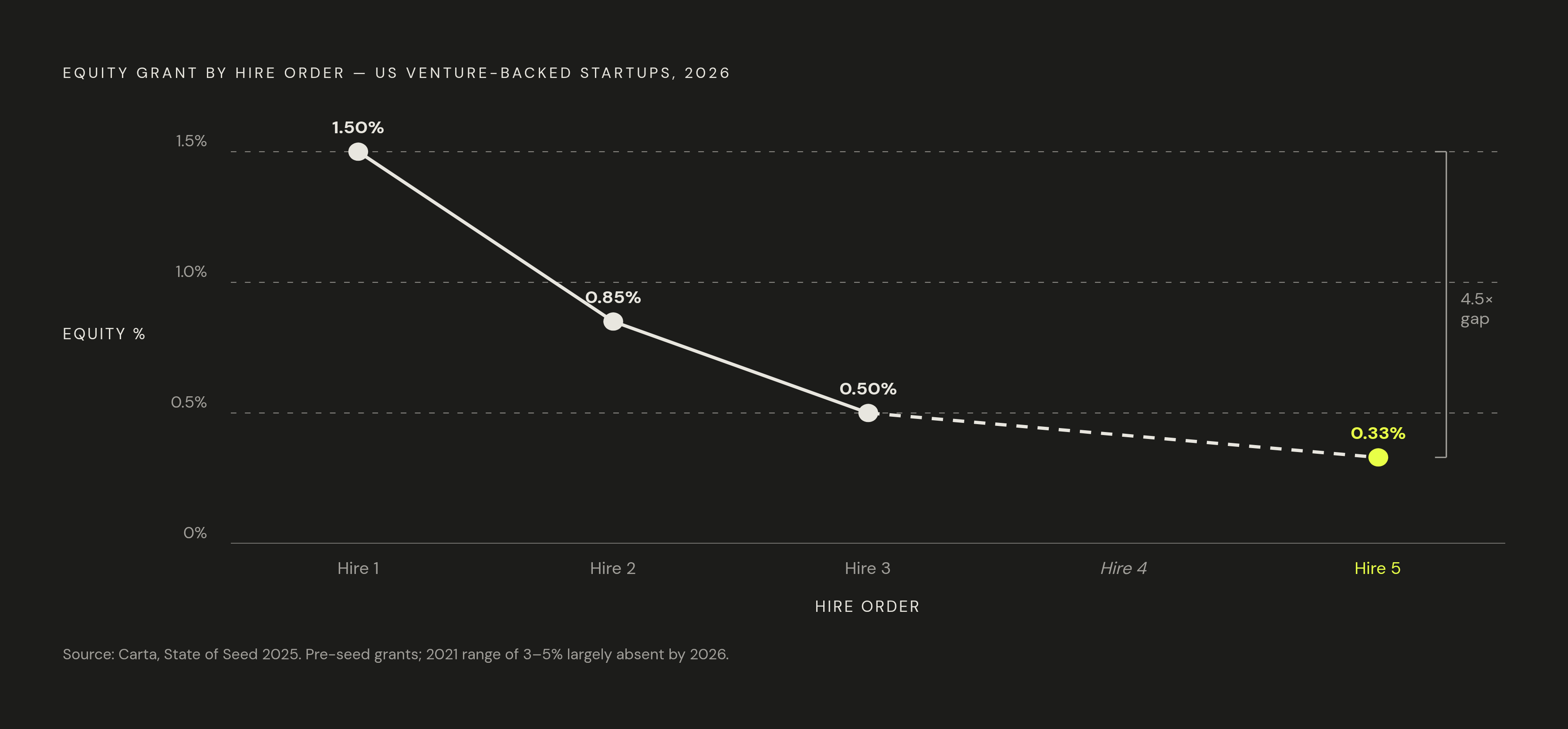
Evaluating a startup offer means separating cash from uncertain ownership value. Equity needs a framework that accounts for dilution, exit probability, and vesting structure, rather than the treatment given to RSUs at a large public employer. A grant percentage is only a starting point. This distinction is especially important in Tier 5, where equity is the main variable offered in exchange for lower cash.
Founding engineer packages form a separate comparison set. At US venture-backed startups in 2026, pre-seed packages run from $160K–$220K base with 0.75%–2.5% equity. At Seed, packages are $190K–$270K with 0.40%–1.50% equity, and at Series A, they are $240K–$340K with 0.25%–1.00% equity. These benchmarks apply specifically to founding hires within the broader early-stage robotics market. Applying them to every startup engineering role would repeat the same mistake as using one salary for all robotics work.
Join order changes the ownership outcome substantially. Carta’s State of Seed 2025 report says the first technical hire gets average equity of 1.5%, which drops to 0.85% for hire two, 0.5% for hire three, and 0.33% by hire five. The 3–5% grants that were common in 2021 are now mostly gone. The realistic upper limit for pre-seed founding hires is now 1–2.5%. A founding title alone does not establish where a grant should fall.
Competition has pushed in the other direction at the bottom of the range. With frontier labs offering $400K–$600K in total compensation, pre-seed startups have to offer more equity because they cannot match the cash, which raises the equity floor. Both pressures can exist at once. High-end grants have compressed even as scarce AI talent gains leverage over the minimum ownership on offer. The result still needs to be judged against the risks of the particular startup.
The research engineer vs. ML engineer vs. research scientist pay distinction at robotics companies
Research engineer, ML engineer, and research scientist are not interchangeable compensation labels. At frontier labs, the pay gap between a research scientist and an ML engineer is real but smaller than many candidates assume. The credential bar and daily work differ more. Those determine which track is available before salary negotiation begins.
The frontier-lab benchmark is usually for someone with a PhD, publications, and frontier-model expertise. It does not establish a universal eligibility rule for every research-scientist opening, or a fixed pay increment between all three titles. Title alone is not enough to price the role. A research-adjacent offer needs comparison with the actual work and entry requirements, rather than an assumed premium for the word “research.”
How to negotiate a robotics offer when you know which market you are actually in
Negotiation should be anchored to the specific sub-discipline, employer tier, and city. That choice can mean a $50K–$150K swing in base salary before equity enters the discussion. Use posted-wage data for that market. The BLS median of $122,930 for SOC 17-2199 is not the offer target, because its mix includes lower-paying automation and integration roles.
For software and controls tracks, use what humanoid and AI-first companies pay to draw engineers out of adjacent roles as the relevant competitive benchmark. A manufacturing integrator’s rate for the same title does not set the practical negotiating limit. If you specialize in robot learning, VLA, or physical AI, document the production systems you have shipped on physical hardware. At Tier 3 and above, that evidence moves offers more than simulation results alone because it demonstrates the scarce combination employers are buying.
For an early-stage offer, ask for the fully diluted cap table, the liquidation preference stack, and the last-round valuation. Negotiating ownership value requires evaluating grant percentage and those inputs alongside dilution risk, exit probability, and vesting structure.
Price the actual track and scope of the job. A description that asks for a robot learning engineer but budgets for a ROS platform engineer will lose the candidate at the offer stage or fail to attract one at all.