How Top ML Engineers Actually Get Hired at AI Startups
Referrals, public work, and production proof beat job boards.

Summary
Referrals, public work, and production proof beat job boards.
Top ML engineers get hired at AI startups far more often through referrals, the communities they take part in, and work they share in public than through job boards. The hiring process then turns on specific fit, production evidence, and speed. A curated talent marketplace for elite ML and software engineers should match people to the actual job, show work samples that can be trusted, and send interview invitations with salary bids upfront.
Why the ML engineering title now covers five different jobs, and why that matters before anything else
“ML engineer” is an umbrella label for at least five different jobs in 2026. The distinctions are not cosmetic. A research scientist originates methods, usually with a PhD and first-author papers, although requirements vary. Anthropic does not formally require a PhD or publications for most ML research roles. A research engineer turns research ideas into experiments that run at scale and, more and more often, co-authors papers, though they may not have a doctorate.
A production ML engineer is in charge of the model lifecycle from training through deployment, monitoring, and retraining. This is the person with the pager. An ML infrastructure or platform engineer builds the distributed-training and GPU systems that make that work possible, so the role is closer to SRE than data science. An applied AI or LLM engineer builds products on foundation-model APIs and may never train a model.
A scientist who wants to develop methods can be miserable shipping features, while a production engineer can be equally frustrated by research with no route to deployment. When the work includes training pipelines, feature engineering, and model metrics, it points to production ML. RAG, agents, prompt evaluation, and APIs point to applied AI engineering.
What the production ML engineer actually does all week, and why most JDs miss it
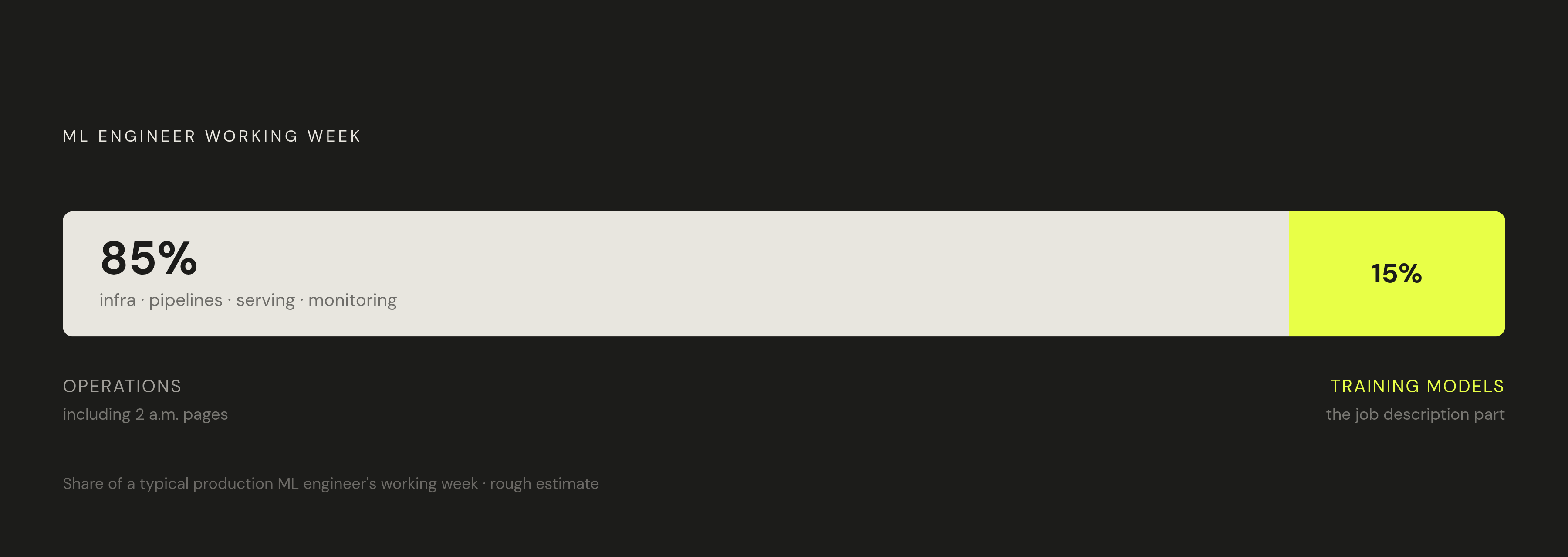
Training models accounts for roughly fifteen percent of a production ML engineer’s working week. The rest is what keeps the system usable. Infrastructure, pipeline maintenance, serving, and monitoring make up the other eighty-five percent, including the work behind a page at 2 a.m. A job description centered on model training therefore describes a small part of the job while obscuring most of its responsibility.
That gap also distorts what “senior” means. Years spent training models or a strong Kaggle leaderboard position do not establish that someone can own a model that drives real revenue. Production debugging is the stronger predictor. Can the candidate explain a coherent playbook for diagnosing a latency spike or silent model degradation?
For a startup, the lesson is to hire for a realistic combination of strengths. The engineer who is genuinely strong across all five lanes does not exist at the salary band most startups post. Two adjacent lanes are a more plausible match. Production ML with a strong lean toward MLOps often works well because it pairs work on models with the job of keeping them running. When a job description asks for every specialty, it is harder to tell what the job is.
Where do AI startups find pre-vetted ML engineers before job boards see them?
The scarcest engineers, who almost never apply to anything, are being recruited, co-authoring work, or working on side projects. Companies that reach them first already have a presence where that work is visible. That makes sourcing less about collecting applications, which curated networks like Fonzi, a recruiting platform that screens only the top 0.1% of ML and software engineers and recommends them directly to AI startups, avoid by design, and more about recognizing relevant ability before an engineer formally enters the market.
For founding AI engineer searches, the founder’s prior work network is the most common sourcing win. Other places to look are the YC talent network for YC-backed companies, AI startup alumni who want to help found another company, Recurse Center batches, and people who contribute to open-source AI projects. These are different routes to people whose work or working relationships are already visible, rather than a single pool of interchangeable applicants.
An engineer can be part of a community with only a small audience. Consistent, substantive contribution is what makes an engineer findable. That can mean writing about a problem solved, contributing to a Discord server or Slack group, presenting at a local ML meetup, or building a useful tool. For a startup looking for pre-vetted engineers, those channels provide evidence to investigate. A referral opens the conversation, while the work establishes whether it is worth continuing.
What makes an ML engineer’s profile findable and credible to a startup that is actually looking
A resume makes claims that public work can substantiate. A merged pull request to a major framework, a deployed model on Hugging Face, or a widely used open-source tool gives a startup something concrete to assess. A long list of frameworks, course certificates, an unsupported claim of LLM experience, or forked repositories without original commits offers much less to examine.
For engineers, the recommended order is fundamentals, hands-on LLM experience, and visible artifacts. Fundamentals include Python, PyTorch or JAX, linear algebra, and probability. Hands-on experience includes fine-tuning, RAG pipelines, and agent frameworks. The portfolio then gives those skills a concrete form. It should show work done rather than repeat the same skills under a different heading.
That evidence also needs a clear lane. Applying to production ML, LLM application work, and MLOps with the same resume usually weakens all three applications because the reader has to infer the intended fit. For someone without a formal AI title, a focused contract project can supply both the title and a production story. Building an LLM feature for a client is one such route.
For senior candidates, how they explain their choices tells more than which programming language they name. They should explain model selection, evaluation metrics, overfitting, and data leakage in words a non-technical person can follow. Credentials can still support the case. They cannot replace an account of what was built, why particular trade-offs were made, and what the result required of the engineer.
How the interview loop at an AI startup actually works, and what it is really testing
A typical AI startup loop includes coding, ML fundamentals, system design, a project deep-dive, and a behavioral round. The design exercise might ask for a recommendation system, a RAG pipeline, or a monitoring setup. The common test is production fluency. For a production role, answers about training-serving skew, drift monitoring, on-call tickets, and postmortems reveal more relevant experience than a discussion framed entirely around research hypotheses.
That is why a LeetCode gauntlet is counterproductive for most AI startup roles. Most of the engineers the company wants to hire already have jobs, and abstract coding exercises do not test the real LLM failure modes they would need to handle. A work sample gets closer to the job. For a founding AI engineer, the highest-signal format presents the company’s actual AI problem and asks for a proof-of-concept architecture covering RAG design, quality measurement, eval dataset construction, and cost per query.
A production scenario adds another useful test. The company can ask how the candidate would diagnose a hallucination rate in production, fix it, and prevent regression. The revealing parts are evals, telemetry, prompt versioning, and rollback strategy.
For candidates, preparation should center on the project deep-dive. A clear account of trade-offs, failures, and monitoring decisions is more useful than memorized architecture trivia. Frontier labs are a distinct case. At Anthropic, the stages include a multi-stage coding assessment and structured LLM-inference system design, which fits a workplace where engineers do research and researchers ship code. Candidates should prepare for the role they are seeking, since AI companies differ in what they test.
Why hiring speed determines which companies actually close the engineers they want
The best candidates can be off the market within days. A slow process does not simply collect more evidence. It changes who remains available, removing candidates with other options before the company can act on its assessment. A demanding hiring standard has little practical effect if the engineers who meet it have already accepted elsewhere.
For companies, the lesson is to decide within a week of the final stage. That is a way to maintain the hiring standard and keep the decision connected to the candidate pool the company intended to hire from. A curated, invitation-style process with salary bids upfront also respects that timeline, rather than leaving basic terms unresolved until late in the conversation.
Speed alone does not make an offer compelling. At the Principal IC level, equity does more work than cash, while founding engineer conversations turn heavily on equity timing, vesting, and the founder’s ability to sell the vision credibly. Candidates also assess whether the problem is authentic, whether the founder understands AI, and whether the company has a data advantage. A fast process gets the offer into consideration. The substance still has to earn acceptance.
Where pedigree still matters — frontier-lab alumni and the founding engineer market
Production evidence is not the whole story at the narrowest end of this market. Having worked at a frontier lab and being part of a network carry real weight in founding-engineer searches and the tightest talent pools. A portfolio cannot fully reproduce that provenance.
The founding engineer role also differs from both a standard IC position and a technical co-founder role. A technical co-founder bets on the company and shapes its technical direction. A founding engineer executes the founder’s vision with meaningful equity. That distinction changes what each side is evaluating, because the conversation is not only about whether someone can perform a defined technical job.
The reverse-acquihire pattern is the most extreme expression of the value placed on provenance. Larger players have absorbed entire AI company teams primarily to bring in particular people and their accumulated research credibility. At the frontier, the team’s history has value of its own. This is a different hiring context from filling a production role with a clear operational remit.
The exception does not justify general credentialism. At mid-career and below, where most hiring happens, production evidence is more reliable than credential proxies. Even at the founding and frontier levels, pedigree works with a demonstrated ability to ship. For most startups, the useful search remains for someone who has done the specific hard thing, rather than someone with a particular school or lab attached to their name.
How to read the market clearly as an engineer deciding where to move next
For an engineer considering a move, the first decision is which kind of work to pursue. AI startups, particularly Series A and B companies, offer high-leverage opportunities for people who want to shape technical direction. Many need a research engineer who can advance research and ship. The exception is a company whose product is research output itself.
Demand also gives the portfolio a useful direction. Agentic AI is the fastest-growing skill cluster in postings, covering systems that take actions inside real workflows. Work that has shipped and uses tool use, planning architectures, and multi-agent coordination meets that demand.
Engineers should assess iteration speed, technical founder fluency, data advantage, and equity structure, just as the company assesses technical fit. A slow or opaque hiring process is itself a signal about how the business runs. An invitation with an upfront salary bid gives the candidate a clearer basis for deciding whether to engage.
For engineers quietly open to a move, the practical recommendation is to make relevant public work findable. A deployed model, a maintained open-source tool, or a technical post circulating in the right Discord gives someone a reason to start a specific conversation.

